
Introduction
U.S. healthcare organizations are under sustained pressure. According to the AHA's 2025 Health Care Workforce Scan, 1 in 5 healthcare workers left their organizations in 2023, and the U.S. faces a projected physician shortage of 86,000 by 2036. Meanwhile, AMA data shows physician burnout still affects 41.9% of physicians, and AMN Healthcare reports that 72% of nurse leaders experience burnout sometimes, often, or always.
Those numbers have a common thread: organizations that invest in structured training retain more staff, reduce safety risk, and pull ahead of competitors who don't.
Still, many HR leaders, facility directors, and training consultants are being asked to build healthcare training programs from scratch — usually reactive, rarely with a clear process. The early decisions made in that situation shape everything that follows.
This guide covers what healthcare training solutions actually involve, what to assess before you build anything, and how to launch programs that hold up under real-world conditions.
TL;DR
- Healthcare training solutions close skill gaps, meet compliance requirements, and improve both staff performance and patient outcomes.
- Start with a genuine needs assessment, not assumptions carried over from last year's training calendar.
- Curriculum should cover compliance, clinical skills, communication, and mental fitness — all four areas matter.
- Pilot before you scale; skipping this step is expensive.
- Measure outcomes tied to your original objectives, not just completion rates.
What Are Healthcare Training Solutions?
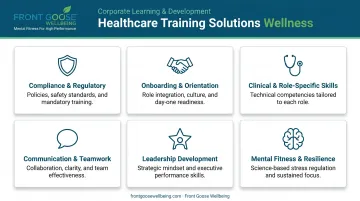
Healthcare training solutions are structured learning programs that equip staff with the clinical, compliance, interpersonal, and performance capabilities needed to deliver safe, consistent care. The scope is broader than most organizations initially plan for.
These programs vary significantly in format and purpose:
- Compliance and regulatory training: HIPAA, OSHA bloodborne pathogen rules, workplace violence prevention
- Onboarding and orientation: integrating new hires and establishing baseline competencies
- Clinical and role-specific skills training: technical skills, simulation, and competency assessment
- Communication and teamwork training: tools like AHRQ's TeamSTEPPS, an evidence-based framework for improving patient outcomes through structured communication
- Leadership development: capability building for managers and department heads
- Mental fitness and resilience training: stress management, cognitive resilience, and focus under pressure
The Joint Commission draws a clear line between education and training and competency assessment. Training delivers knowledge; competency assessment confirms a staff member can apply that knowledge correctly in a care setting. Programs that treat these as separate, measurable milestones consistently produce stronger outcomes than those that conflate them.
What to Know Before You Launch
Most healthcare training programs start in the wrong place. A compliance incident triggers a new module. Survey scores drop and leadership wants communication training. Turnover spikes and onboarding gets a hasty refresh.
Reactive launches produce programs that treat symptoms. The underlying behavior, system issue, or knowledge gap driving the problem stays intact.
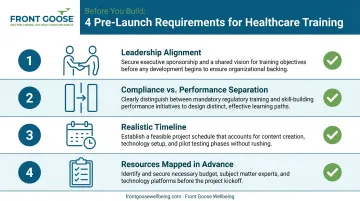
Getting the foundation right before building anything is what separates programs that actually change behavior from those that just fill calendar slots. Four things need to be true before a single course is built:
- Leadership is aligned on goals — if decision-makers won't protect time for learning or actively support participation, even a well-designed program will struggle to reach the people who need it most.
- Compliance training and performance training are treated as separate priorities — compliance keeps your organization legally protected; performance training builds the capabilities that improve outcomes and retention. Treating them as the same leads to programs that check boxes but don't change behavior.
- The timeline is realistic — a comprehensive rollout from needs assessment to full launch typically takes longer than anticipated. Trying to shortcut the process creates gaps in content quality, compliance coverage, and facilitator readiness.
- Resources are mapped in advance — internal L&D capacity, technology infrastructure, and budget should be confirmed before scoping, not after.
According to Gallup's 2023 State of the Global Workplace report, disengaged employees cost organizations an estimated $8.8 trillion in lost productivity globally. In industries where burnout, turnover, and knowledge gaps compound each other, the cost of a poorly launched training program isn't just wasted budget — it shows up in attrition, errors, and the performance ceiling your teams never break through.
How to Launch Healthcare Training Solutions — Step by Step
The sequence below is a practical execution framework for healthcare organizations, HR leaders, and training consultants. The most common failure point isn't any single step : it's rushing or skipping the earlier ones.
Step 1: Conduct a Training Needs Assessment
Start with data, not assumptions. A thorough needs assessment gathers evidence from:
- Performance reviews and competency evaluations
- Patient outcome metrics and incident reports
- Compliance audit findings
- Direct staff feedback through surveys, interviews, or focus groups
A 2024 public health workforce review found that surveys were used in 74% of training needs assessment cases — structured, not anecdotal. The goal is to map actual gaps against both regulatory requirements (HIPAA, OSHA, Joint Commission standards) and operational outcomes.
That mapping tells you what to build first. It also clarifies where existing off-the-shelf content is sufficient versus where custom development is actually necessary.
Step 2: Define Your Audience and Set Measurable Objectives
A single program built for "all staff" will underserve everyone. Segment your audience by role, department, and current competency level : what a bedside RN needs differs significantly from what a department manager or a home health aide needs.
Write specific, measurable learning objectives before building content. The difference matters:
| Weak objective | Strong objective |
|---|---|
| "Improve staff awareness of medication policies" | "Reduce medication documentation errors by 15% within 90 days" |
| "Increase understanding of safety protocols" | "All staff pass competency assessment on fall prevention protocol" |
| "Enhance communication skills" | "Reduce escalated conflict incidents in Unit 4 by 20%" |
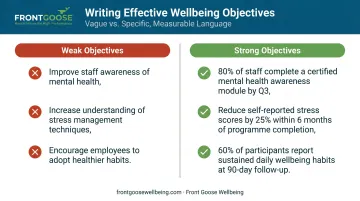
Objectives grounded in operational outcomes create accountability and make evaluation possible. They also force honest conversations about whether training is actually the right intervention or whether the issue is a process, staffing, or systems problem.
Step 3: Design the Curriculum and Choose a Delivery Model
For most healthcare settings, a complete curriculum covers five areas:
- Compliance and safety — HIPAA, OSHA, accreditation requirements, workplace violence prevention
- Clinical or role-specific skills — technical competencies matched to role and department
- Communication and conflict resolution — particularly high-value given how directly teamwork affects patient safety
- Leadership development — for managers and charge staff who influence culture and performance
- Mental fitness and resilience — the most underutilized component, and the highest-leverage one given current workforce conditions
On that last point: physician burnout still affects 41.9% of physicians, and 72% of nurse leaders report experiencing burnout. These aren't wellness statistics. They're performance and safety variables. Staff who are cognitively depleted make more errors, communicate less effectively, and leave faster.
Evidence-based mental fitness training — covering stress management, focus under pressure, breathwork, and cognitive resilience — directly addresses this gap. Organizations like Front Goose Wellbeing deliver structured programs grounded in neuroplasticity principles, customizable for healthcare settings and delivered as workshops, cohort sessions, or multi-day retreats.
Front Goose programs are led by Megan Dittman, a Board Certified Health & Wellness Coach (NBC-HWC) and Neuroleadership Institute-certified coach with 25+ years of Fortune 500 HR leadership experience. GE Aerospace participants reported "greater clarity and reduction in stress," along with measurable improvements in focus and performance.
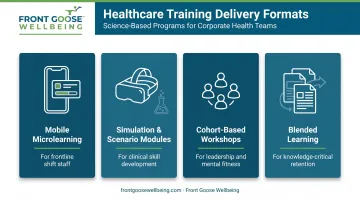
On delivery format: choose based on how your staff actually work.
- Mobile-accessible microlearning for frontline staff on shift schedules
- Simulation and scenario-based modules for clinical skill development
- Cohort-based workshops for leadership, communication, and mental fitness topics
- Blended approaches for anything where knowledge retention is critical (a 2023 systematic review found blended learning outperformed traditional formats for both knowledge and skills retention in healthcare settings)
Step 4: Select Technology, Partners, and Confirm Compliance Readiness
Your LMS selection should be driven by actual requirements, not brand recognition. Key features to evaluate:
- Compliance tracking and certification management
- Automated recertification reminders
- Role-based assignment and completion reporting
- SCORM and xAPI support (these standards ensure interoperability and allow tracking of learning experiences across platforms)
- Mobile compatibility for shift-based staff
- Audit-ready reporting for HIPAA, OSHA, and accreditation reviews
On content sourcing: map your internal L&D capacity honestly before deciding what to build versus buy. Compliance content and standard onboarding modules can often be sourced externally or adapted from existing materials. Specialized content (clinical simulation, mental fitness training, leadership coaching) typically benefits from external partners with verified credentials and track records.
Before launch, confirm that all training content, delivery platforms, and any data handling practices meet applicable regulatory standards.
Step 5: Pilot the Program Before Full Rollout
Run the program with a representative pilot group before organization-wide launch. "Representative" means multiple roles, departments, and experience levels : not just the staff who volunteered first.
Collect structured feedback on:
- Content clarity and accuracy
- Relevance to actual job conditions
- Pacing relative to shift schedules
- Technical access and platform usability
Train facilitators before the pilot, not after. Instructor variability directly causes uneven training outcomes. Standardized delivery guidelines and facilitator coaching matter more than most organizations expect.
Common issues that surface in pilots include modules too long for shift constraints, knowledge checks that don't actually validate competency, and content that's technically accurate but contextually wrong for the specific setting. Better to find these in a pilot group of 20 than after rolling out to 500.
Step 6: Measure Results and Build a Continuous Learning Culture
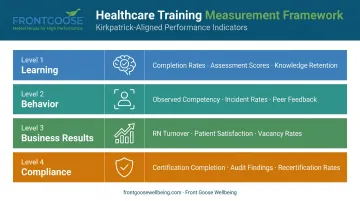
Define your measurement framework before launch — before, not after. Metrics should connect directly to the objectives you wrote in Step 2 and operate at multiple levels:
| Level | What to track |
|---|---|
| Learning | Completion rates, assessment scores, knowledge retention |
| Behavior | Observed competency, incident rates, peer/supervisor feedback |
| Business results | RN turnover, first-year exits, patient satisfaction, vacancy rates |
| Compliance | Certification completion, audit findings, recertification rates |
Review program performance at regular intervals. Retire content that's no longer current. Add modules where new gaps emerge. Recognize staff engagement in ways that reinforce the value of ongoing development : not just as a compliance checkbox.
Common Mistakes Healthcare Organizations Make When Launching Training
Three patterns consistently derail healthcare training launches before they gain traction.
Skipping or rushing the needs assessment. Organizations frequently build compliance modules in response to an audit finding without identifying the behavior or system issue that drove the non-compliance. The module gets completed; the problem recurs.
Treating mental fitness as optional. Burnout is documented, widespread, and directly tied to performance and retention outcomes. NSI's 2024 data shows each percentage point change in RN turnover represents $262,500 saved or lost per average hospital.
Treating that financial exposure as a staffing problem alone misses the point. Front Goose Wellbeing describes the mind as a performance tool that requires structured training — a view gaining traction across high-performance organizations. Classifying mental fitness as a wellness perk rather than a core performance component is an expensive mistake.
Scaling before the program is stable. Launching organization-wide before the pilot is complete, before facilitators are trained, or before the LMS is fully configured creates confusion and erodes staff trust. Course-correcting a program already deployed at scale is significantly harder, and costlier, than fixing it in a pilot.
Frequently Asked Questions
What are the 4 types of training programs?
The four commonly recognized types are onboarding and orientation, compliance training, skills and technical training, and leadership or professional development. High-performing healthcare programs typically include meaningful elements of all four rather than treating any single category as sufficient on its own.
What is the best learning management system for healthcare organizations?
The right LMS depends on your organization's size, compliance requirements, and specific use case. Prioritize compliance tracking, certification management, mobile accessibility, SCORM/xAPI support, and audit-ready reporting. Evaluate platforms through a structured needs-based process rather than defaulting to the most widely marketed option.
How long does it take to launch a healthcare training program?
A basic compliance-focused program can be deployed within a few weeks. A comprehensive program covering clinical skills, compliance, and performance training typically takes 3-6 months from needs assessment through full rollout.
Should healthcare organizations build training in-house or outsource it?
It depends on internal L&D capacity, content complexity, and budget. Onboarding and standard compliance content can often be managed internally. Specialized areas — clinical simulation, mental fitness training, leadership coaching — typically benefit from credentialed external partners with relevant subject matter expertise.
How do you measure the effectiveness of a healthcare training program?
Measure at multiple levels: learner reaction, knowledge retention, behavior change on the job, and impact on business metrics like incident rates, turnover, and patient satisfaction scores. Completion rates alone are not a proxy for effectiveness.
What topics should always be included in a healthcare training program?
Core topic areas include compliance and regulatory requirements, clinical or role-specific skills, communication and conflict resolution, emergency preparedness, and mental fitness and resilience. Given documented burnout rates across the U.S. healthcare workforce, that last category has moved from optional to essential.