
Introduction
The most effective business development professionals often aren't running ads or working cold call lists — they're standing in front of a room. Speaking engagements have become one of the highest-trust prospecting channels available, particularly for service-based businesses, consultants, and advisors who need to demonstrate expertise before a client will consider hiring them.
A single well-executed speaking event can accomplish what months of email outreach cannot. According to the 2024 Edelman-LinkedIn B2B Thought Leadership Impact Report, 73% of decision-makers said thought leadership is a more trustworthy basis for assessing a vendor's capabilities than marketing materials. Speaking puts that credibility on display in real time.
This article breaks down the main types of speaking engagements used for business prospecting, how each format works differently, and how to choose the one that fits your goals and target audience.
TL;DR
- Speaking engagements let professionals demonstrate expertise directly to qualified prospects, building trust faster than traditional marketing
- 73% of B2B decision-makers trust thought leadership more than traditional marketing materials
- The five main formats are: keynote presentations, corporate training workshops, webinars, networking events and roundtables, and Q&A or fireside chat sessions
- Each format serves a different prospecting goal — broad awareness vs. direct decision-maker access
- The right format depends on your audience, topic, and how deep a client relationship you need to build
What Are Speaking Engagements for Business Prospecting?
A speaking engagement for business prospecting is any structured public or private speaking event — in-person or virtual — where a professional uses their platform to demonstrate expertise, connect with potential clients, and generate new business relationships.
Unlike general public speaking, the goal here isn't to inform or entertain — it's to position the speaker as the trusted authority their audience wants to hire or refer. That distinction matters: speaking as prospecting is a direct lead generation tool, not a passive branding exercise.
Speaking engagements create direct access to audiences that would otherwise require multiple cold outreach attempts to reach.
Research from Hinge Marketing found that 67% of "Visible Experts" ranked speaking engagements as their most impactful marketing technique — ahead of writing a book (61%) and traditional referrals (54%).
Why Speaking Engagements Are a Powerful Business Prospecting Tool
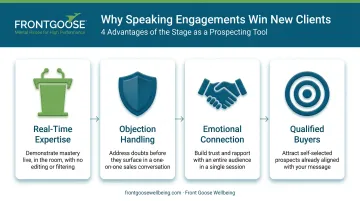
Speaking engagements compress the trust-building process. In a single session, a speaker can demonstrate real expertise, address common objections through content, and create genuine connection with an audience of qualified prospects.
Without this strategy, professionals relying solely on cold outreach or passive content marketing often face a structural disadvantage. Demand Gen Report data shows 80% of B2B buyers initiate first contact only after they're approximately 70% through the buying journey — and 81% already have a preferred vendor when they make that first contact. If you haven't established authority before the sales conversation begins, you're already behind.
That's where topic-audience alignment becomes the key multiplier. When a speaker's subject matter directly addresses a pain point the audience is already feeling, the prospecting impact grows significantly. Sessions like Megan Dittman's "The Performance Edge: Managing Stress & Building Cognitive Resilience" and "Wellbeing as a Leadership Advantage" connect precisely because HR leaders and executive teams are already searching for answers to workforce stress and leadership performance challenges — the content meets them where they are.
What makes speaking especially effective:
- Demonstrates expertise in real time, not through static credentials
- Handles common objections through content before the sales conversation
- Creates emotional connection that email and content marketing rarely achieve
- Puts you in front of qualified buyers who self-selected by attending
Types of Speaking Engagements for Business Prospecting
Not all speaking engagements serve the same prospecting purpose. The format shapes the audience size, the depth of connection, and the type of business relationship that typically follows.
Two variables help distinguish them: audience reach (broad vs. targeted) and relationship depth (awareness-building vs. direct decision-maker access). Two variables help distinguish them: audience reach (broad vs. targeted) and relationship depth (awareness-building vs. direct decision-maker access). Each format below sits differently on both dimensions — which is what makes choosing the right one strategic, not arbitrary.
Keynote Presentations at Conferences and Industry Events
A keynote is a featured address — typically 30 to 60 minutes — delivered at the opening or closing of a conference, summit, or industry event. The speaker sets the tone for the event and is positioned as the primary thought leader for that audience.
Who benefits most: Speakers who want to reach a large concentration of qualified prospects at once. Conference audiences typically consist of professionals, executives, and decision-makers already invested in the topic.
Bizzabo's 2025 State of Events report found 78% of event organizers consider in-person events their organization's most impactful marketing channel — and 57% reported attendance at in-person B2B conferences grew in the prior year.
Key trade-offs:
- High perceived prestige and strong post-event visibility
- Limited one-on-one interaction time
- Conversion to client relationships requires deliberate follow-up strategy
Corporate Training Workshops and Leadership Seminars
A corporate training workshop is a skills-based or insight-driven session delivered directly inside a company — to its employees, managers, or executive team. Formats range from a 60-minute lunch-and-learn to a full-day or multi-day immersive program, typically arranged by HR leaders or talent development teams.
Best suited for: Consultants, coaches, and service providers whose work requires ongoing engagement. This format provides direct access to organizational decision-makers and creates a natural pipeline to longer-term contracts or retainer relationships.
The business case is significant. Training Magazine's 2025 Industry Report shows U.S. training expenditures reached $102.8 billion, with organizations outsourcing 62% of instruction and facilitation — a substantial pool of budget actively seeking qualified external trainers. The business case is significant. Training Magazine's 2025 Industry Report shows U.S. training expenditures reached $102.8 billion, with organizations outsourcing 62% of instruction and facilitation — a substantial pool of budget actively seeking qualified external trainers.
Documented results from corporate mindfulness and mental fitness programs reinforce the demand: organizations have reported 20–37% productivity gains and 30–40% reduced stress levels after structured training interventions.
Key trade-offs:
- One of the highest-converting formats — the organization has already trusted you enough to invite you in
- Can itself be a paid engagement, not just a prospecting activity
- Harder to land cold; typically requires prior credibility or referral
Webinars and Virtual Speaking Events
A webinar is an online seminar or workshop delivered via video conferencing tools. It can be self-hosted, co-hosted with a partner organization, or delivered as part of a virtual event series.
Best suited for: Speakers looking to reach a geographically distributed audience, test new topic areas, or nurture prospects who aren't yet ready to make a purchase decision.
The format has grown significantly. Goldcast's analysis of 19,000+ webinars found B2B webinar production increased 225% in 2024, with the average webinar attracting 238 registrants at a 33% attendance rate. Additionally, 65% of buyers considered webinars valuable in 2024, up from 52% the year prior.
Key trade-offs:
- Low logistical cost with potential for wide reach
- Produces reusable content assets (recordings, clips, lead magnets)
- Lower intimacy than in-person; drop-off rates are high without strong enough content to hold attention
Networking Events, Roundtables, and Panel Discussions
Roundtables bring together a small group of industry professionals for facilitated discussion. Executive roundtables create intimate forums of typically 10–20 senior leaders around a defined business challenge. Panel discussions involve multiple speakers addressing shared topics before a live audience.
Ideal if: You want to build peer relationships with decision-makers rather than present to them from a stage. C-suite leaders and HR executives often engage more authentically in conversation than as passive audience members.
This matters because buyers are increasingly peer-driven. Demand Gen Report found 72% of buyers cited a vendor's strong knowledge of their company and needs as the top reason for selecting a winning vendor — and that knowledge is best demonstrated in conversation, not from a stage.
Key trade-offs:
- Faster relationship-building and more direct access to decision-makers
- Limited audience size — depth over reach
- Panels require active, substantive contributions to avoid being overshadowed by co-panelists
Q&A Sessions, Expert Interviews, and Fireside Chats
In Q&A sessions, an expert responds to live questions from the audience or a moderator. Fireside chats are structured conversations between a host and subject matter expert in a conversational tone. Expert interviews follow a similar format and are often recorded for content repurposing.
Best suited for: Speakers comfortable with unscripted dialogue who want to demonstrate depth in real time. These formats signal genuine expertise — you're responding dynamically, not following a prepared script.
Trust matters enormously in this context. LinkedIn's 2025 B2B Marketing Benchmark found 94% of B2B marketers agreed trust is the key factor in B2B success — and conversational formats build it faster than polished presentations.
Key trade-offs:
- Humanizes the speaker and creates authentic connection
- Content produced is reusable across multiple channels
- Requires strong facilitation; off-topic questions can derail without preparation
How to Choose the Right Speaking Format
The right format isn't the most prestigious one — it's the one most likely to put you in the room with the people who have both the authority and the need to hire you. Start with the audience, not the format.
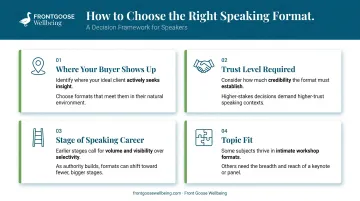
Four factors to guide your decision:
Match the format to where your buyer already shows up — HR leaders attend talent summits and SHRM events; C-suite leaders appear at executive roundtables and CEO forums. Speak where your decision-maker is, not where you prefer to be.
Consider how much trust your services require — Coaching, consulting, and ongoing programs need relationship depth first. Prioritize formats that allow real conversation. If you're building broad awareness, keynotes or webinars serve that goal.
Stage of your speaking career — Panels, roundtables, and webinars are accessible entry points for emerging speakers. Keynotes and corporate training sessions require demonstrated credibility or a referral relationship to land.
Topic fit — Some subjects need space for reflection, not just information delivery. Leadership coaching, stress management, and mental resilience land harder in workshops or roundtables — formats where participants can process and respond, not just listen.
When in doubt, pick the format that gets you closest to a real conversation with the right person. Proximity to the buyer beats platform size every time.
Mistakes to Avoid When Prospecting Through Speaking
Even well-prepared speakers lose prospecting opportunities to a handful of avoidable errors. Here are the three most common ones:
Choosing Format for Status Over Fit
Pursuing a keynote at a massive conference before building relationships in smaller, targeted forums often produces high visibility and low conversion. The audience isn't qualified enough, or there's no follow-up infrastructure to capture interest.
No Clear Next Step After the Event
Every speaking engagement used for prospecting needs a mechanism for continued connection: an opt-in resource, a follow-up offer, or a specific call to action that moves interested audience members into a relationship. Without it, momentum dissipates within days.
Generic Content That Misses the Room
Demand Gen Report found 51% of B2B buyers said content was too generic and irrelevant in 2024, up sharply from 38% the prior year.
Assuming the audience wants a broad overview of your expertise almost always produces low engagement. Research the specific pressures your audience faces before you step on stage — then address those directly.
Conclusion
Speaking engagements remain one of the most efficient prospecting tools available because they build credibility, create visibility, and open relationships — all in a single interaction that no cold outreach sequence or passive content strategy can replicate on its own.
But the format matters. Each type of engagement serves a different prospecting goal, and intentional selection based on audience, topic, and desired relationship depth determines whether a speaking opportunity generates real pipeline or just applause.
The speakers who build consistent pipelines don't wait to be invited. They identify which format puts them in front of their ideal clients — and pursue those opportunities deliberately.
Frequently Asked Questions
What is the 3:2:1 rule in speaking?
The 3:2:1 rule is a presentation structure framework: cover 3 key points, support them with 2 stories or examples, and close with 1 clear call to action. For business prospecting purposes, the single call to action is the most critical element — it's what moves an interested audience member into an actual business conversation.
What are the 5 C's of public speaking?
The 5 C's are Confidence, Clarity, Conciseness, Credibility, and Connection. In a business prospecting context, credibility and connection do the heaviest lifting. Credibility establishes why the audience should trust you; connection determines whether they'll want to continue the relationship after the event ends.
What are the 3 C's of public speaking?
The 3 C's are Clarity, Conciseness, and Confidence. These matter most in prospecting contexts, where audience members are evaluating whether the speaker truly understands their challenges — and whether they'd trust them with solving those problems.
What types of speaking engagements are best for reaching corporate decision-makers?
Executive roundtables, corporate training workshops, and panel discussions at industry events provide the most direct access to HR leaders, C-suite executives, and talent development directors. Large keynote formats build awareness effectively but offer limited opportunity for the intimate follow-up conversations that convert to client relationships.
How do speaking engagements help with lead generation for service-based businesses?
Speaking engagements convert more efficiently than most outbound marketing because the speaker is demonstrating expertise in real time, reducing skepticism and shortening the trust-building timeline. Qualified prospects who attend self-select their interest, making post-event conversations far warmer than cold outreach alone.