The challenge for HR leaders isn't whether to invest in wellness — it's choosing the right type of program. Most corporate wellness platforms address physical health, step counts, or generic perks. Stress management is a different problem. It requires science-backed, mind-focused interventions that change behavior, not just provide content.
This article ranks five corporate wellness companies specifically suited to address workplace stress, with a clear-eyed look at what each does well, who it's best for, and where each falls short.
TL;DR
- Workplace stress costs employers millions annually — generic wellness programs rarely reduce absenteeism, burnout, or lost productivity
- The best providers use evidence-based methods: mindfulness, mental fitness coaching, CBT, and resilience training
- Credentials matter: look for NBC-HWC accreditation, Neuroleadership Institute training, and clinically validated content
- Front Goose Wellbeing leads this list for its 25+ years of Fortune 500 HR experience backed by science-based mental fitness methods
- Selection criteria: delivery method, practitioner credentials, corporate fit, measurable outcomes, and customization
What Are Corporate Wellness Companies for Stress Management?
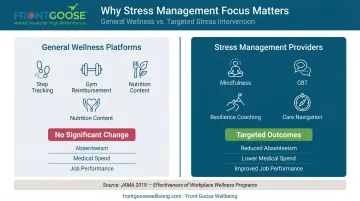
Not every wellness vendor addresses stress the same way. General wellness platforms and stress-focused providers operate on fundamentally different models — with measurable differences in outcomes.
General wellness platforms typically offer:
- Step challenges and fitness tracking
- Gym reimbursements
- Nutrition content and biometric screenings
Stress management-focused providers offer:
- Mindfulness and meditation training
- Mental fitness coaching and resilience programs
- Cognitive behavioral techniques (CBT)
- Care navigation and therapy access
- Manager mental health training
The distinction matters because a 2019 JAMA randomized trial found that a general workplace wellness program improved self-reported health behaviors but produced no significant change in medical spending, absenteeism, tenure, or job performance after 18 months. Stress, burnout, and cognitive performance require targeted interventions. Participation incentives alone don't move those numbers.
The five companies below share a common thread: structured, evidence-informed methods that go beyond surface-level wellness perks.
Top Corporate Wellness Companies for Stress Management
These providers were evaluated on depth of stress management programming, practitioner credentials, proven corporate outcomes, and suitability for executive teams and high-performing workforces.
Front Goose Wellbeing
Front Goose Wellbeing was founded by Megan Dittman, a former HR Executive with 25+ years at corporations including GE, Kohler, and Woolpert. She's one of the few wellness practitioners who has lived corporate pressure from the inside — and built her credentials around it:
- Board Certified Health & Wellness Coach (NBC-HWC) — accredited through the National Board of Medical Examiners
- Certified Meditation Instructor — Chopra Institute
- Coaching certifications — Neuroleadership Institute
- Master's in Industrial Labor Relations — Cornell University
What Front Goose delivers is distinct from both app-based platforms and generic coaching services. Programs are built on neuroplasticity research — the principle that repeated mental practice physically rewires the brain's neural connections, improving focus, emotional regulation, and stress response.
Corporate engagements are fully customizable and delivered through:
- Instructor-led mindfulness training
- The RISE Executive Leadership Retreat (a multi-day immersive program)
- Team retreats
- Group coaching
Clients across organizations including GE Aerospace, University of Cincinnati, and Associated Materials have reported 20–37% productivity gains and 30–40% stress reduction.
| Attribute | Detail |
|---|---|
| Focus Area | Science-based mental fitness: mindfulness, meditation, neuroplasticity training, and resilience coaching for business leaders, teams, and executives |
| Ideal For | Fortune 500 companies, executive teams, high-performing corporate workforces, and elite performers seeking measurable stress reduction and performance improvement |
| Key Differentiator | 25+ years of corporate HR executive experience combined with NBC-HWC accreditation and Chopra Institute certification — understands both the neuroscience and the corporate environment |
Headspace for Work
Headspace for Work is the enterprise arm of the Headspace mindfulness app, offering a scalable digital platform for employee stress management through guided meditation, sleep content, and mental health exercises.
It carries the strongest independent research backing of any app-based platform on this list. A peer-reviewed employee RCT found significant improvements in well-being, distress, and job strain among app users over eight weeks. A more recent Headspace/UCSF employee study of 1,400+ people with no prior mindfulness experience reported 27% lower perceived stress after eight weeks of use. Those who averaged at least five minutes per day showed greater reductions, with improvements sustained at four-month follow-up.
Headspace is self-directed and lacks human facilitation. It scales well, but measurable behavioral change at the leadership level typically requires more than on-demand content.
| Attribute | Detail |
|---|---|
| Focus Area | Guided meditation, mindfulness exercises, sleep improvement, and stress reduction via a self-directed digital platform |
| Ideal For | Mid-to-large organizations wanting scalable, on-demand mental wellness access for a distributed workforce |
| Key Differentiator | Strongest independent research evidence of any app-based platform; highly scalable but less personalized than coaching-led programs |
Lyra Health
Lyra Health is a mental health benefits platform connecting employees to therapists, coaches, and self-guided care — covering the full spectrum from everyday stress to clinical concerns. It's available to nearly 20 million people globally and has delivered over 10 million care sessions since 2015.
Lyra uses evidence-based treatment matching (CBT, mindfulness-based stress reduction) and navigates employees to the appropriate care level — a significant advantage over traditional EAPs, which SHRM's 2024 toolkit found are unknown to 26% of employees at companies that offer them. Lyra publishes vendor-reported outcomes including 87% clinical improvement for clients combining Guided Practice Sessions with live therapy, though these figures are vendor-published and should be verified against independent sources.
| Attribute | Detail |
|---|---|
| Focus Area | Mental health care navigation, therapy, coaching, and clinical stress management through a curated provider network |
| Ideal For | Larger organizations needing to address both clinical mental health needs and everyday stress under one benefits umbrella |
| Key Differentiator | Vetted network of therapists and coaches with evidence-based treatment matching — bridges EAP-style support with proactive stress management |
Calm Business
Calm Business brings the Calm app's consumer familiarity into an enterprise context, offering guided meditations, breathing exercises, sleep stories, and anxiety reduction content for workplace use.
The adoption advantage is real: millions of employees already use Calm personally, which reduces onboarding friction significantly. Calm's 2024 Voice of the Workplace report — drawn from 4,000+ employees and 150+ U.S. HR leaders — found 69% of employees said their mental health stayed the same or worsened in the past year. That's a useful benchmark, but it applies to the problem, not the product. Calm Business hasn't published product-specific stress or utilization outcomes. Ask vendors for customer-specific outcome data before committing.
| Attribute | Detail |
|---|---|
| Focus Area | Meditation, breathing techniques, sleep improvement, and anxiety reduction via a consumer-friendly digital platform |
| Ideal For | Organizations looking for a low-friction, high-adoption stress management benefit employees can use independently |
| Key Differentiator | High name recognition and a large expert-narrated content library; best as a supplement to a broader strategy rather than a standalone solution |
Wellable
Wellable is a comprehensive corporate wellness platform covering physical, mental, financial, and social wellness dimensions. Its stress management offering includes on-demand mindfulness content, resilience education, and structured wellness challenges — all managed through a single platform with a dedicated Customer Success Manager.
For HR teams managing multiple wellness vendors, consolidating under Wellable can reduce administrative overhead while maintaining meaningful mental health programming. Stress management is one component within a broader platform rather than a core specialization. Research turned up no publicly available, product-specific stress outcome or utilization data — buyers should request customer references and pre/post stress measures directly.
| Attribute | Detail |
|---|---|
| Focus Area | Holistic wellness platform covering physical, mental, and financial health — stress management addressed through mindfulness content, challenges, and education |
| Ideal For | Organizations building a full wellness ecosystem with stress management included as one pillar |
| Key Differentiator | Breadth of programming across wellness dimensions with strong admin support and incentive structures |
What Makes a Corporate Wellness Company Effective for Stress Management?
Not all corporate wellness programs deliver measurable stress reduction. The ones that do share three qualities worth scrutinizing before you sign a contract.
Evidence-Based Methodology
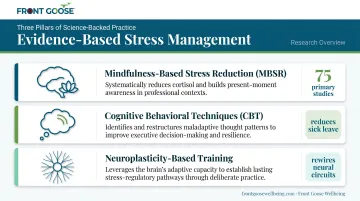
Effective programs reference specific mechanisms — not just "wellness content." Look for:
- Mindfulness-Based Stress Reduction (MBSR) — a 2021 realist review of 75 primary studies found workplace mindfulness programs help employees manage stress more skillfully
- Cognitive Behavioral Techniques (CBT) — a 2023 review found CBT-based interventions effective at reducing sick leave and facilitating return to work
- Neuroplasticity-based training — behavioral change requires repeated practice to rewire neural circuits, not one-off webinars
Practitioner Credentials
Credentials are the clearest signal that programming is grounded in validated methodology, not wellness aesthetics. Key credentials to look for:
- NBC-HWC (National Board Certified Health & Wellness Coach) — accredited by the NBME
- Certified Meditation Instructor — look for training from accredited programs such as the Chopra Institute
- Neuroleadership Institute coaching certifications
- Licensed therapists or clinical credentials for providers offering EAP-adjacent services
Measurability
A serious stress management partner should be able to report outcomes — not just usage. Ask potential vendors for:
- Pre/post stress assessments
- Absenteeism and productivity change data
- Reporting tools your HR team can access
- References from organizations similar to yours in size and workforce profile
How We Chose the Best Stress Management Wellness Companies
Selection focused on companies that solve a specific problem — not general wellness, but the kind of chronic stress, burnout, and performance pressure that shows up in leadership teams and high-stakes environments. Each company on this list met four criteria:
- Demonstrable stress management focus — not a broad wellness platform with stress as a checkbox
- Credentialed practitioners or clinically backed content — certified instructors, licensed clinicians, or peer-reviewed methodology
- Proven corporate application — evidence of real deployment with organizations, not just individual users
- Capacity to serve executive and high-performing teams — appropriate scope, delivery model, and depth
The most common mistake organizations make when choosing wellness vendors is selecting based on brand familiarity or platform aesthetics. A step-counting app and a science-based mental fitness program are solving different problems. If your workforce challenge is executive burnout, chronic stress under pressure, or leadership resilience — the vendor's methodology needs to match that specific problem.
The right question to ask any vendor: does this program change how my people think and respond under pressure — not just what they know about stress?
Conclusion
Stress management is a performance strategy. The right corporate wellness partner should deliver measurable outcomes in resilience, focus, and productivity — not just employee satisfaction scores.
Before evaluating vendors, define your organizational stress profile. Are you addressing executive burnout? Team-level resilience in high-pressure environments? Broad employee mental health access? Each challenge calls for a different type of provider.
For organizations that need stress management programs built on both neuroscience and real corporate experience, Front Goose Wellbeing is worth a close look. Founder Megan Dittman brings 25+ years of Fortune 500 HR leadership alongside certifications from the Chopra Institute, Cornell, and the Neuroleadership Institute — delivering programs designed for the realities of corporate performance, not generic wellness checklists.
Frequently Asked Questions
What companies offer corporate wellness programs?
Corporate wellness providers include digital platforms like Headspace for Work, Calm Business, and Wellable; specialized coaching firms like Front Goose Wellbeing; and clinical care platforms like Lyra Health. The right fit depends on whether you need broad digital access or targeted, expert-led programming for executive teams.
What is the best corporate wellness program for stress management?
It depends on workforce size, the type of stress being addressed, and your goals. For high-performing teams and executive leadership, a credentialed coaching provider with direct corporate experience will consistently outperform a general wellness app.
How do corporate wellness companies help reduce employee stress?
Effective providers use evidence-based methods such as mindfulness practice, cognitive reframing, guided meditation, and resilience training to address the neurological roots of workplace stress. Programs grounded in neuroplasticity research require repeated practice — which is why on-demand content alone rarely produces lasting results.
What credentials should I look for in a corporate stress management provider?
Key credentials include NBC-HWC accreditation through the National Board of Medical Examiners, Certified Meditation Instructor credentials from accredited institutions such as the Chopra Institute, coaching training from the Neuroleadership Institute or Chopra Institute, and relevant clinical certifications for providers offering therapy or EAP services.
What is the difference between a wellness app and a mental fitness coaching program?
Wellness apps deliver self-directed content at scale but lack personalization and accountability. Mental fitness coaching programs involve credentialed practitioners who deliver structured, customized programs designed to produce measurable behavioral change. For executive teams and high-performance environments, the latter is the more appropriate choice.
How much do corporate stress management programs cost?
Pricing varies and is rarely published publicly. Digital platforms charge per employee per month; specialized coaching programs are custom-quoted based on scope and organization size. Compare cost against concrete outcomes — well-designed programs can deliver 20–37% productivity gains, 30–40% stress reduction, and 200–1,100% ROI — rather than platform pricing alone.