Yet most organizations respond with gym memberships and snack bars. A JAMA randomized clinical trial found that a multicomponent workplace wellness program produced no significant differences in healthcare spending, absenteeism, or job performance after 18 months. Generic perks don't reach the cognitive and physiological roots of stress.
Mind-body wellness training programs do. By targeting how the brain actually processes and responds to stress — through meditation, breathwork, mindful movement, and neuroplasticity-based coaching — these programs build the kind of mental resilience that shows up in performance metrics, not just satisfaction surveys.
TL;DR
- Workplace stress costs U.S. employers $47.6B+ annually in lost productivity — generic wellness perks don't move that number
- Mind-body programs target the neuroscience of stress directly, reducing cortisol and strengthening prefrontal cortex function through repeated practice
- The strongest programs combine credentialed facilitation, scientific grounding, and team-specific customization
- Top programs to evaluate: Front Goose Wellbeing, SIYLI, MBSR corporate programs, Headspace for Work, and Calm Business
- Evaluate trainer credentials, delivery format, ROI measurement, and workforce fit before committing
What Are Mind-Body Wellness Training Programs?
Mind-body wellness training programs are structured, facilitated interventions that use evidence-based practices (meditation, mindful movement, breathwork, cognitive coaching) to regulate the body's stress response and strengthen mental performance over time.
that distinction is critical.
Best Mind-Body Wellness Training Programs for Workplace Stress
The programs below were evaluated on scientific grounding, facilitator credentials, corporate suitability, delivery flexibility, and documented outcomes.
Front Goose Wellbeing
Front Goose Wellbeing, founded by Megan Dittman, occupies a rare position in the corporate wellness space: it combines 25+ years of Fortune 500 HR executive experience with a stack of clinical and coaching certifications that most wellness providers can't match.
Megan's certifications span multiple disciplines:
- Chopra Institute Certified Meditation Instructor
- RYT-200 Yoga Instructor
- Board Certified Health & Wellness Coach (NBC-HWC, accredited by the National Board of Medical Examiners)
- Coaching certifications from the Neuroleadership Institute
Her corporate background spans GE, Kohler, and Woolpert — she's not translating academic theory into business language. She already speaks both.
Programs are built on neuroplasticity science, treating mental fitness the way elite athletes treat physical conditioning: the more you practice focused attention, the stronger the neural connections become. Outcomes cited by the company include 20–37% productivity gains and 30–40% stress reduction.

Front Goose serves clients nationwide — "Made in North Carolina, Flying Everywhere" — including GE Aerospace, Kohler Corp, the University of Cincinnati, and other Fortune 500 organizations.
| Program Format | In-person and virtual; customized corporate engagements including workshops, group coaching, keynote speaking, and executive retreats |
| Key Modalities | Neuroplasticity coaching, science-based meditation, breathwork, mindful movement, mental fitness training |
| Best Suited For | Corporate executive teams, high-performing business leaders, Fortune 500 organizations |
Search Inside Yourself Leadership Institute (SIYLI)
SIYLI originated inside Google as an internal leadership development program and now operates independently, delivering structured mindfulness and emotional intelligence training worldwide.
The program combines neuroscience, mindfulness practice, and the Goleman emotional intelligence framework in a format built specifically for workplace leaders. SIY Global reports data from 14,000+ participants across 20+ countries, with 93% of surveyed participants saying they would recommend the program.
| Program Format | In-person and virtual two-day workshops; follow-up online modules available |
| Key Modalities | Mindfulness meditation, attention training, emotional intelligence development |
| Best Suited For | Leadership teams, mid-to-senior managers, organizations prioritizing EQ development |
Mindfulness-Based Stress Reduction (MBSR) Corporate Programs
MBSR is the most clinically validated structured mindfulness program available. Created by Dr. Jon Kabat-Zinn at UMass Medical School in 1979, it's the most clinically researched mind-body program available. A 2018 PLOS One systematic review found that MBSR may improve psychological functioning in employees, with results that hold up across diverse workplace populations.
Many certified MBSR instructors now adapt the curriculum for corporate cohorts. The critical caveat: effectiveness depends heavily on instructor certification and curriculum fidelity. Brown University's Mindfulness Center is among the leading institutions offering recognized MBSR teacher training pathways.
| Program Format | 8-week cohort program; available in-person, virtual, or hybrid |
| Key Modalities | Body scan, sitting meditation, mindful movement (gentle yoga), group dialogue |
| Best Suited For | Organizations seeking evidence-based stress reduction with measurable clinical outcomes |
Headspace for Work
Headspace for Work is a digital-first corporate mindfulness platform offering guided meditation, focus sessions, and stress management content accessible by app across an entire workforce. It scales easily to distributed or global teams without logistical complexity.
Its evidence base is stronger than most app-based wellness tools. A workplace RCT found that app-delivered Headspace significantly reduced perceived stress in UK university employees. A separate UCSF employee study reported reductions in stress, job strain, and burnout. The main limitation: a 2022 JMIR literature review found mHealth studies are consistently hampered by participant dropout and attrition — without active engagement supports, usage tends to fade.
| Program Format | Digital platform (mobile app); enterprise licensing; self-paced |
| Key Modalities | Guided meditation, focus sessions, breathing exercises, sleep improvement |
| Best Suited For | Large, distributed, or hybrid workforces needing a scalable, low-cost entry point |
Calm Business
Calm Business is the enterprise version of the consumer Calm app. It provides organizations with access to sleep, meditation, and stress management content, plus admin dashboards for usage tracking.
Its strongest differentiation is sleep content — particularly relevant for high-stress roles where cognitive recovery depends on sleep quality. Calm Health reports that 37% of users with moderate-to-severe anxiety or depression screening results engaged in therapy, and members showed 2x higher engagement in outpatient mental health care compared to a baseline group. Without a structured curriculum or facilitated accountability, behavior change tends to be inconsistent — making it better suited as a supplement than a standalone program.
| Program Format | Digital platform; enterprise subscription; integrates with HR benefits stacks |
| Key Modalities | Sleep stories, guided meditation, breathwork, stress check-ins |
| Best Suited For | Companies seeking a mental wellness supplement to existing EAP or wellness programs |
What Makes a Mind-Body Wellness Training Program Effective?
Not all programs deliver. The difference between meaningful behavior change and an expensive shelf item comes down to four factors.
Trainer Credentials Over Brand Recognition
The most common mistake organizations make: selecting a program by name recognition instead of verifying what the facilitator actually holds.
Credentials that signal rigorous, standardized training:
- NBC-HWC (National Board of Medical Examiners): sets the benchmark for health and wellness coaching rigor
- Chopra Certified Meditation Instructor: 150 hours of learning, practice teaching, and formal evaluation
- Neuroleadership Institute BBCC: 60+ ICF-accredited hours grounded in neuroplasticity-based leadership coaching
- RYT (Yoga Alliance): teacher credentialing based on registered school training standards
Brand recognition and polished apps don't substitute for verified credentials — especially when measurable behavioral change is the goal.
Customization to Your Workforce's Stress Profile
Effective programs start with a needs assessment. The dominant stressors in an executive team — decision fatigue, leadership pressure, strategic ambiguity — look very different from team-level cognitive overload or burnout in high-volume operational roles. Generic programs applied uniformly rarely produce measurable outcomes because they're solving for an average that doesn't exist.
Front Goose Wellbeing takes this seriously: programs are built around organizational goals, with modalities selected based on what a specific workforce actually needs — not a pre-packaged curriculum.
Delivery Format Must Match Workforce Reality
| Format | Strengths | Limitations |
|---|---|---|
| Live facilitated (in-person or virtual) | High engagement, accountability, behavioral change | Less scalable, higher cost |
| Digital self-paced (app) | Scalable, accessible, lower cost | High dropout, limited accountability |
| Hybrid (live + digital reinforcement) | Sustained behavior change, flexibility | Requires coordination to execute well |
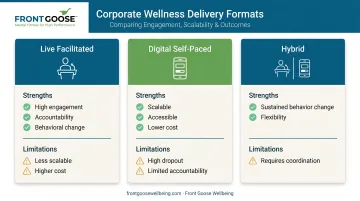
Hybrid models — live facilitation paired with digital practice tools — consistently produce the strongest sustained behavior change. Organizations like GE and Kohler have used this structure to embed wellness practices beyond a single training event.
ROI Measurement and Program Accountability
Programs without built-in measurement frameworks are nearly impossible to justify to leadership. SHRM and IFEBP both emphasize tracking both financial ROI and broader "Value of Investment" (VOI) metrics.
Key indicators to track:
- Self-reported stress scores (pre/post assessments)
- Absenteeism rates and unplanned absence frequency
- Productivity proxies (output metrics, manager assessments)
- Healthcare claims or EAP utilization changes
- Employee engagement and retention scores
Define these metrics before launch — not after. Programs with baseline data in place are far easier to renew, scale, or expand to additional teams.
Conclusion
Workplace stress is a performance problem. Organizations that treat it that way — investing in science-backed, facilitator-led, measurable interventions — see results show up in output, retention, and leadership capacity.
The programs on this list take very different approaches, and the right fit depends on your team's stress profile, workforce size, and what you're actually trying to change. If the goal is meaningful behavioral shift for high-performing leaders and executive teams, app-based tools won't carry that weight on their own — that's where facilitator-led, customized training makes the difference.
Front Goose Wellbeing offers science-based mental fitness training built specifically for corporate leaders and high-performance teams — grounded in neuroplasticity research and led by Megan Dittman, a former Fortune 500 HR executive with 25+ years at companies like GE, Kohler, and Woolpert, and certifications from the Chopra Institute and Neuroleadership Institute. To explore what a customized program might look like for your organization, schedule a discovery call with Megan Dittman.
Frequently Asked Questions
What are the 5 C's of stress management?
UCLA STAND's framework identifies the 5 C's as Connect, Capable, Contribute, Calm, and Care — practices designed to prevent and manage anxiety and stress. Organizations can apply this model by building team connection rituals, reinforcing employee competence, creating space for meaningful contribution, and integrating calming practices into the workday.
What are the best corporate wellness programs?
The strongest corporate wellness programs combine evidence-based design, certified facilitation, and customization to workforce needs. For stress and cognitive performance, structured mind-body programs like Front Goose Wellbeing, SIYLI, and MBSR consistently outperform generic EWPs by targeting the physiological and cognitive roots of stress.
What is a mind-body wellness training program?
A mind-body wellness training program is a structured, evidence-based intervention using practices like meditation, breathwork, yoga, and neuroplasticity coaching to address both the physiological and cognitive dimensions of stress. Unlike generic wellness offerings, these programs are designed to change how the brain responds to pressure over time.
How do you measure the ROI of a mind-body wellness program?
Key metrics include absenteeism rates, self-reported stress scores, productivity indicators, healthcare cost trends, and EAP utilization. Establish pre-program baselines and track changes at 90-day intervals to build a credible ROI case for leadership.
What is the difference between a wellness program and a mental fitness training program?
Traditional wellness programs target physical health outcomes: fitness, nutrition, and biometric screenings. Mental fitness training programs develop cognitive resilience, emotional regulation, and stress response management — directly tied to performance outcomes like focus, decision-making, and leadership under pressure.