Introduction
It's 9:47 AM. You've already been in two meetings, your inbox has 34 unread messages, and the quarterly report is due by noon. You're physically present, but mentally scattered — that familiar cognitive fog settling in before the real work even begins.
This is the daily reality for millions of professionals. The real cost? Chronic stress doesn't just feel bad. It actively degrades the thinking skills your job demands most: working memory, decision-making, emotional regulation, and sustained focus.
How you respond to stress is trainable. Meditation is a neuroscience-backed mental fitness practice used by Navy SEALs, Fortune 500 executives, and elite athletes to build measurable cognitive resilience — not a soft wellness trend reserved for yoga retreats.
This article covers:
- Why workplace stress is a performance problem worth taking seriously
- What meditation actually does to your brain under pressure
- Five practical techniques you can use during the workday
- How to build a habit that sticks
TLDR
- Workplace stress costs U.S. employers over $300 billion annually — the impact shows up directly in productivity, retention, and decision-making
- Five evidence-backed meditation techniques can each be practiced in under 20 minutes during the workday
- Breathing tools like box breathing and 4-7-8 breathing deliver immediate nervous system relief requiring no equipment or preparation
- Consistency beats duration: 5-10 minutes daily produces real cognitive changes over time
- Organizations that build meditation into team culture report 20-37% productivity gains and 30-40% reductions in stress
Why Workplace Stress Is a Performance Problem
The business case has a number attached to it.
According to the American Institute of Stress, job stress costs U.S. employers more than $300 billion annually through absenteeism, turnover, decreased productivity, and healthcare costs — a balance sheet problem, not just a wellness concern.
What Stress Does to Your Best Thinkers
The cognitive toll is specific and severe. Research by Arnsten in Nature Reviews Neuroscience shows that stress directly impairs prefrontal cortex functions — the brain regions responsible for:
- Holding and manipulating information in real time (working memory)
- Filtering distractions and sustaining focus (attention regulation)
- Evaluating options, managing risk, and learning from outcomes (decision quality)
- Responding proportionally rather than impulsively (emotional regulation)
These aren't peripheral capabilities. They're the core skills every high-performing role depends on.
Acute vs. Chronic Stress
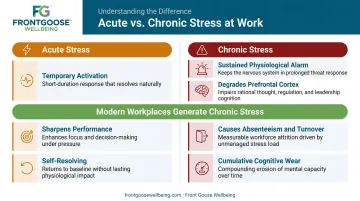
Not all stress is harmful. Acute stress — a tight deadline, a high-stakes presentation — can sharpen performance temporarily. The problem is chronic stress, where the physiological alarm never fully turns off.
Modern workplaces are exceptionally effective at generating chronic stress: always-on communication, blurred boundaries, constant context-switching, and performance pressure that doesn't pause. Our brains weren't designed for sustained activation. The wear is cumulative — and it surfaces as the absenteeism rates, turnover costs, and decision errors that meditation techniques are specifically designed to address.
How Meditation Rewires the Brain Under Pressure
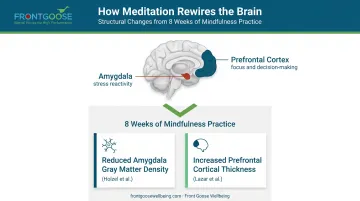
Your amygdala — the brain's threat-detection system — can't tell the difference between a physical threat and an aggressive email. It fires the same fight-or-flight response either way.
In a chronically stressed professional, this system stays overactivated. That persistent state is what degrades focus, inflates reactivity, and shortens decision-making quality.
The Neuroplasticity Mechanism
The brain is not fixed. Neuroplasticity — the brain's capacity to rewire itself through repeated experience — means that structured mental practice produces structural change.
The research is specific. A landmark study by Holzel et al. found that 8 weeks of mindfulness-based stress reduction correlated with decreases in right basolateral amygdala gray matter density — meaning a measurable reduction in the brain's stress-reactivity hardware. A separate study by Lazar et al. found experienced meditators showed increased cortical thickness in prefrontal regions associated with attention and decision-making.
Structural changes in the brain translate directly into functional ones — and that's where the default mode network becomes relevant.
Taming the Wandering Mind
One of meditation's most actionable effects is suppressing the default mode network (DMN) — the brain's background chatter responsible for mind-wandering and rumination. Research shows experienced meditators demonstrate decreased DMN activity during practice.
Why does this matter at work? A 2013 study by Mrazek et al. found that just two weeks of mindfulness training improved working memory capacity and reading comprehension performance while reducing mind-wandering. Less mental drift equals better output.
Mindfulness vs. Meditation: A Useful Distinction
These terms get conflated. Here's the practical difference:
- Meditation = the structured practice (the training session)
- Mindfulness = the skill developed through that practice (present-moment awareness without judgment)
Meditation builds the capacity; mindfulness is how that capacity shows up in real decisions, conversations, and high-stakes moments at work. Both matter — but conflating them obscures how to develop each deliberately.
Five Meditation Techniques for Workplace Stress Relief
Different techniques serve different needs. Some work best as a morning reset; others are better suited for mid-day recovery or real-time emotional regulation. Try more than one.
Mindfulness Meditation
How it works: Sit quietly, focus on the breath as an anchor, and observe thoughts without engaging them. When the mind drifts — and it will — return attention to the breath without self-judgment. Even 5-10 minutes before the workday begins shifts your baseline.
Why it works at work: Mindfulness builds the critical pause between stimulus and response. Instead of reacting automatically to a tense message or a last-minute change, you gain just enough space to choose your response. That pause is worth more than most leadership training programs.
The research supports it:
- A 2022 study of 220 adults found a 10-minute practice decreased perceived stress and reduced sustained-attention errors.
- Research by Wu et al. found 15 minutes daily for 7 days improved emotion processing and lowered attentional bias toward negative stimuli.
Body Scan Meditation
How it works: Systematically direct attention from the feet upward through each body part, noticing sensations without judgment. It takes 5-15 minutes and requires no equipment — just a chair.
Why it works at work: Stress accumulates physically — jaw tension, tight shoulders, shallow breathing — well before it registers mentally. A body scan surfaces these early signals and interrupts the physical stress cycle before it escalates into full cognitive impairment. A pilot study of healthcare professionals found 8 weeks of MBSR (which included body scans) produced significant decreases in emotional exhaustion and stress.
Mantra Meditation
How it works: Silently repeat a calming word or phrase to displace anxious or scattered thoughts. Practice with eyes closed for 5-20 minutes, or use a brief mantra as a grounding tool during a stressful moment.
Why it works at work: High-achieving professionals often struggle with open-awareness meditation styles — the mind wants a task. A mantra gives the overactive problem-solving brain a structured focal point, making mental stillness more accessible. A randomized trial of teachers and school staff found Transcendental Meditation practiced 15-20 minutes twice daily reduced perceived stress, depression, and emotional exhaustion.
Front Goose Wellbeing offers Primordial Sound Meditation, a mantra-based practice rooted in Chopra Institute methodology, where each practitioner receives a personal mantra derived from their birth date, time, and location. For executives who find breathwork-focused meditation difficult to sustain, this structured, personalized approach removes the most common barrier to consistent practice.
Attention-Based (Focused Attention) Meditation
How it works: Choose a single anchor — your breath, an object, or a mantra — and hold focused attention on it. Each time the mind wanders, return without self-criticism. Start with 60 seconds twice daily and build from there.
Why it works at work: This is the most directly transferable technique to professional performance. The evidence is specific:
- A study of 379 health professionals found brief focused attention training produced immediate, workplace-relevant stress reductions.
- Emergency medicine participants reported measurable improvements in calmness under acute pressure.
The mechanism is direct: repeatedly redirecting attention trains the same neural circuits that drive focus, sustained concentration, and emotional regulation on the job.
Loving-Kindness (Compassion) Meditation
How it works: Silently direct phrases of goodwill — "May I be well. May I be at peace." — toward yourself, then toward colleagues, including difficult ones. 5-10 minutes is enough to shift your emotional baseline.
Why it works at work: Chronic stress amplifies the internal critic, increases interpersonal friction, and erodes empathy — exactly when leaders need it most. Two randomized controlled trials by Zeng et al., involving over 580 employees, found online loving-kindness and compassion meditation reduced job burnout, turnover intention, and psychological distress. For people managers and senior leaders, the relational return on this practice is substantial.
Breathing Exercises You Can Use Between Meetings
When you need relief in the next 90 seconds — not the next 90 days — controlled breathing is the fastest tool available. It directly activates the parasympathetic nervous system, counteracting the fight-or-flight response within seconds. No app, quiet room, or prior training required.
Three Techniques Worth Knowing
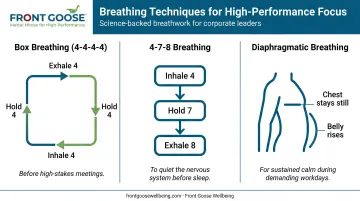
Box Breathing (4-4-4-4)
Inhale for 4 counts → hold for 4 → exhale for 4 → hold for 4. Repeat 4 cycles. Used by military personnel and first responders for acute stress regulation. Ideal before a high-stakes meeting or difficult conversation.
4-7-8 Breathing
Inhale for 4 counts → hold for 7 → exhale for 8. Cleveland Clinic describes this technique as effective for calming the stressed nervous system rapidly. Well-suited for pre-presentation anxiety or mid-afternoon mental fatigue.
Diaphragmatic (Belly) Breathing
Breathe into the diaphragm rather than the chest, allowing the belly to rise. This activates the vagus nerve and triggers the parasympathetic relaxation response. The most discreet option — usable at a desk, during a commute, or before opening a stress-inducing email.
Making It Stick Without Extra Time
Knowing the techniques is half the equation. The other half is actually using them — and that happens when you attach a breathing reset to moments already in your day:
- Before opening email in the morning
- After each meeting ends, before starting the next task
- At the top of each hour as a brief reset
- Before picking up the phone for a difficult call
No new calendar blocks needed. Just a 60-second habit stacked onto existing ones.
How to Build a Sustainable Meditation Habit at Work
The most common mistake people make with meditation is waiting until they have 20 uninterrupted minutes. That day rarely arrives.
Start small. Stack it on something. Five minutes of meditation attached to your morning coffee, your pre-meeting transition, or your end-of-day shutdown is more effective than 30 minutes practiced inconsistently. Research by Basso et al. found brief daily meditation improved attention, memory, mood, and emotional regulation — with effects strengthening after 8 weeks of consistency.
Neurological change is driven by repetition, not duration.
The Organizational Multiplier
Individual habit-building is the foundation — but organizational culture is what scales it.
Gallup data shows managers account for at least 70% of the variance in employee engagement across business units. The same modeling dynamic applies to wellbeing practices — when leaders visibly adopt and normalize meditation, team adoption accelerates.
Practical entry points for organizations include:
- Opening team meetings with 60 seconds of mindful breathing
- Normalizing short mindful breaks between work blocks
- Incorporating breathwork into leadership offsites and retreats
- Framing meditation as mental fitness training, not wellness programming

Front Goose Wellbeing delivers corporate mindfulness programs grounded in Chopra Institute methodology and Neuroleadership coaching principles. Organizations including GE and Woolpert have worked with Front Goose to build these practices into their leadership culture, reporting measurable gains in clarity, stress reduction, and performance under pressure.
Frequently Asked Questions
How do you reduce stress in the workplace?
Identify recurring stressors — workload, relationships, communication patterns — and fix what's structural first. Then layer in acute tools like box breathing and mindfulness for in-the-moment relief, and build daily habits (scheduled breaks, clear boundaries, consistent practice) to stop stress from accumulating.
What are the 5 R's of stress management?
The 5 R's are Recognize, Reflect, Respond, Relax, and Recover. Meditation directly supports at least three — it sharpens awareness to catch stress early, creates the pause needed to respond rather than react, and activates the nervous system regulation required to genuinely relax.
How long do I need to meditate to see results at work?
Research suggests 5-10 minutes daily produces measurable improvements in focus and emotional regulation within weeks. Deeper structural brain changes — reduced amygdala reactivity, stronger prefrontal function — come from longer, more consistent practice, typically 20+ minutes daily over 8 weeks.
What is the difference between mindfulness and meditation?
Meditation is the structured practice; mindfulness is the skill developed through it — specifically, present-moment awareness without judgment. Think of meditation as the training session and mindfulness as the capacity it builds over time.
Can meditation actually improve focus and productivity at work?
Yes. Meditation reduces default mode network activity (the source of mind-wandering), strengthens prefrontal cortex function, and improves emotional regulation. Aetna's mindfulness program reported employees gained an average of 62 minutes of productive work per week — worth approximately $3,000 per employee annually. Google's program reported 20-37% productivity gains and 30-40% reductions in stress.