Introduction
There's a quiet contradiction at the heart of most leadership roles. Leaders are expected to project stability — calm under fire, decisive when it matters, present for their teams — while carrying more organizational stress than nearly anyone else in the building.
The numbers bear this out. According to Gallup, 35% of managers reported feeling burned out "very often" or "always" in 2021, up from 28% the year prior — and managers consistently report worse stress levels, worse physical well-being, and worse work-life balance than the people they manage.
This isn't just a personal health issue. Unmanaged leader stress cascades directly into team performance, decision quality, retention, and organizational health. The stress a leader carries doesn't stay with the leader.
This guide breaks down why leaders experience stress differently, what it costs their teams and organizations, and which science-backed strategies actually build lasting mental fitness at the leadership level.
TL;DR
- Leader stress is structurally different from individual contributor stress — higher stakes, constant visibility, and accountability for others compound in ways most stress models don't address
- Unmanaged stress impairs decision-making, triggers team disengagement, and measurably raises turnover risk
- Chronic stress physically shrinks the brain's capacity for strategic thinking and emotional regulation — this is neurology, not willpower
- Mindfulness, structured recovery, and cognitive reframing produce measurable neurological improvements within weeks
- Building mental fitness requires consistent daily practice, not crisis-response interventions
Why Leaders Experience Stress Differently
Leaders don't just carry their own stress. They absorb organizational anxiety, act as an emotional anchor for their teams, and bear the weight of decisions that directly affect other people's livelihoods. That compounding responsibility creates a fundamentally different stress load than what individual contributors face.
The Three Compounding Stressors
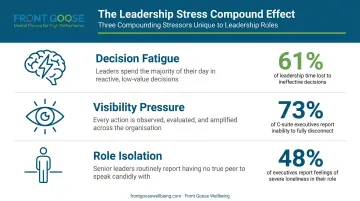
Decision fatigue is a heavier burden than most leaders expect. McKinsey research found that 14% of C-suite executives spend more than 70% of their working time on decisions — and 61% of respondents said most of that decision-making time was used ineffectively. The sheer cognitive load depletes the prefrontal cortex, leaving leaders mentally exhausted by early afternoon while still facing hours of high-stakes work.
Visibility pressure runs constantly in the background. Leaders are watched by their teams, boards, and peers at all times. Maintaining composure during personal difficulty creates a sustained psychological toll that rarely gets acknowledged, let alone addressed.
Role isolation quietly intensifies both pressures. Deloitte research found that roughly one in three executives regularly feel exhausted, overwhelmed, or lonely — and 73% of the C-suite reported their job prevented them from taking time off and disconnecting. The higher leaders climb, the fewer peers they can speak openly with. That structural loneliness is baked into the architecture of seniority, not a personal failing.
Megan Dittman, founder of Front Goose Wellbeing, watched this pattern play out across 25 years as an HR executive at Fortune 500 companies including GE, Kohler, and Woolpert. What she consistently found: leaders understood they were stressed, but lacked practical, science-grounded tools to build lasting resilience.
How Unmanaged Leader Stress Impacts Teams and Organizations
A leader's stress doesn't stay contained. It spreads through tone, decisions, communication patterns, and the emotional signals teams absorb — whether or not anyone names what's happening.
The Cascade Effect
Gallup data shows that 70% of the variance in a team's engagement is attributable to management. When a leader is chronically stressed, that variance skews negative fast.
The mechanisms are specific:
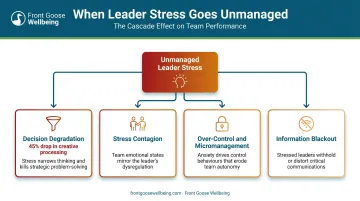
- Decision degradation: Stress narrows cognitive focus through the brain's threat-response system, pushing leaders toward binary thinking, short-term risk aversion, and missed creative solutions. Harvard Business School research found that high time pressure corresponded to a 45% decrease in creative cognitive processing compared to lower-pressure conditions
- Stress contagion: Teams mirror their leader's emotional state. When leaders display hostility or withdrawal, research on abusive supervision shows a direct positive relationship with employee turnover intentions
- Over-control and micromanagement: Leaders feeling a loss of control often compensate by tightening their grip, shutting out advisors, and resisting delegation — compounding dysfunction and eroding psychological safety
- Information blackout: Irritability and emotional volatility reduce team members' willingness to surface problems or flag risks. Leaders become isolated from ground-truth data precisely when they need it most
The Organizational Price Tag
These behavioral breakdowns carry a direct price. Workplace stressors contribute to an estimated $190 billion in healthcare costs annually in the United States, according to Stanford Graduate School of Business research. Workers reporting high stress levels incur healthcare costs nearly 50% higher than lower-stress peers.
Turnover adds to the toll. Deloitte UK found that nearly 40% of total turnover costs are attributable to mental health issues — and 28% of employees had recently left or were planning to leave their jobs.
The Neuroscience of Stress and Leadership Performance
Understanding what chronic stress does to the brain matters for one specific reason: it reframes stress management from a "nice-to-have" into a functional leadership requirement.
What Happens in a Stressed Brain
The amygdala — the brain's threat-detection center — activates when stress hits. Under acute, manageable stress, this sharpens focus. Under chronic stress, it suppresses the prefrontal cortex: the region governingthe capacities leaders rely on most:
- Strategic thinking and complex decision-making
- Emotional regulation and impulse control
- Perspective-taking and interpersonal judgment
This isn't a willpower failure. As Arnsten's landmark neuroscience review documents, even mild uncontrollable stress causes rapid loss of prefrontal cognitive function. The capacities leaders need most are the ones chronic stress degrades first.
The Cortisol-Performance Connection
Short-term cortisol release can sharpen focus — this is the "eustress" effect, and it's useful. The problem is chronic elevation. Sustained high cortisol actively damages neural pathways involved in memory and learning. Leaders operating under persistent stress are working with measurably reduced cognitive capacity, regardless of experience or intelligence.
That's not the end of the story. Harvard-affiliated research found that an 8-week Mindfulness-Based Stress Reduction program produced measurable increases in gray-matter concentration in regions tied to learning, memory, and emotional regulation — while reduced stress correlated with decreased amygdala density.
The brain can be retrained. This is the scientific foundation for practices like Primordial Sound Meditation, breathwork, mindful awareness, and mental rehearsal — techniques Front Goose Wellbeing uses to build lasting cognitive resilience in leaders.

Sleep: The Leadership Blind Spot
Sleep deprivation deserves specific attention here. A study published in Organizational Behavior and Human Decision Processes found that sleep-deprived leaders showed increased hostility and damaged leader-follower relationship quality — and critically, sleep-deprived individuals were not aware of the impact on others' perceptions of them. For leaders, that blind spot can erode trust and credibility before they realize anything is wrong.
Proven Stress Management Strategies for Leaders
Evidence-based strategies fall into three categories: mind-based, body-based, and behavioral. The most effective leaders use all three.
Mind-Based Practices
Mindfulness and meditation aren't relaxation techniques — they're cognitive training. Research shows that 13 minutes of daily guided meditation over 8 weeks improved attention, working memory, recognition memory, and emotional regulation in non-experienced meditators. The same benefits weren't observed after just four weeks, underscoring consistency over intensity.
Front Goose Wellbeing's corporate programs teach modalities including Primordial Sound Meditation and Vipassana alongside breathwork and mental rehearsal — framed as performance tools, not wellness perks.
Cognitive reframing addresses the mental loop of rumination. The core practice is separating what's within a leader's control from what isn't — the "circle of influence" model — and redirecting mental energy toward targeted action.
CBT-based stress management techniques have demonstrated improvements in occupational stress, anxiety, and depression across workplace settings.
Body-Based Practices
Exercise metabolizes cortisol directly. A systematic review found that physical activity lowered cortisol levels and improved sleep quality — and regular exercise has been shown to measurably improve cognitive processing, making it a professional performance input, not just a health habit.
Practical executive formats: walking meetings, a 20-minute morning workout, treadmill desks. The specific format matters less than the consistency.
Sleep is a performance investment. Treat it the same way you treat any other variable that affects output. Specific practices that work:
- Consistent wake time (more important than consistent sleep time)
- Digital cutoff 60 minutes before bed
- A brief pre-bed wind-down routine to downregulate the nervous system
- Tracking sleep quality the same way leaders track other performance metrics
Behavioral and Relational Practices
Strategic pausing before major decisions and communications is simple and underused. A 5–10 minute break before a significant announcement or difficult conversation allows the nervous system to regulate, the prefrontal cortex to re-engage, and the leader to communicate from composure rather than reactive urgency.
Building trusted support networks counteracts the isolation spiral directly. Peer relationships, mentors, coaches, or a trusted inner circle aren't a luxury — social support is a documented stress buffer. Front Goose Wellbeing's group coaching program creates a structured community where senior leaders can process challenges alongside peers who understand the context.
Building a Long-Term Mental Fitness Practice
The most effective leaders treat psychological capacity the way elite athletes treat physical conditioning: through consistent daily training rather than reactive crisis response. Harvard Business Review's "corporate athlete" framework made exactly this argument back in 2001 — sustained high performance requires managing energy recovery as deliberately as physical conditioning. In an era of back-to-back meetings and always-on digital culture, that logic only gets stronger.
A Practical Weekly Framework
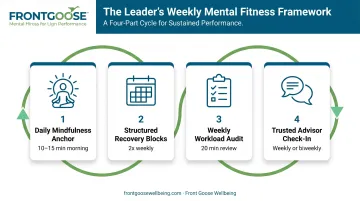
Consistency matters more than perfection. A sustainable weekly rhythm might include:
- Daily mindfulness anchor — 10–15 minutes in the morning before the calendar takes over
- Structured recovery blocks — at least two non-negotiable recovery periods weekly (not just sleep)
- Weekly workload audit — 20 minutes reviewing what's actually on your plate versus what should be
- Regular check-in with a trusted advisor — coach, peer, or mentor, ideally weekly or biweekly
None of these require radical schedule changes. They require treating mental fitness as a non-optional investment rather than something that happens if time permits.
Model It Visibly
When leaders take breaks without apology, set digital boundaries, and speak openly about stress, they create cultural permission for their teams to do the same. That permission is often the missing ingredient in organizational wellbeing efforts.
Visible modeling can look like:
- Blocking focus time on a shared calendar — and keeping it
- Acknowledging stress in team meetings without framing it as weakness
- Starting 1:1s with a genuine check-in rather than jumping straight to tasks
- Leaving at a reasonable hour and not sending late-night messages that signal an always-on expectation
When personal practice becomes visible behavior, resilience stops being a private coping strategy and starts shaping how the whole team operates.
Creating a Stress-Resilient Leadership Culture
Individual practice is necessary but not sufficient. Stress-resilient organizations embed mental fitness into their operating rhythm — not as a standalone program, but as part of how leadership development, meetings, and workload management actually work.
In practice, this looks like:
- Proactive workload reviews that surface unsustainable demands before burnout hits
- Psychological safety norms that make it acceptable to flag overload without penalty
- Structured recovery policies — actual policies, not aspirational language
- Regular pulse checks on leader and team well-being, built into the calendar
The Business Case
A Deloitte UK study found an average return of £5 for every £1 invested in employee mental health support — a 5:1 ratio that holds across industries. Organizations that invest in preventative, organization-wide mental health interventions consistently outperform those that wait for crisis.
Front Goose Wellbeing's corporate mental fitness programs have delivered 20–37% productivity gains and 30–40% stress reduction for partner organizations, with documented ROI ranging from 200% to 1,100% across different implementations. These outcomes come from instructor-led training grounded in neuroplasticity — not wellness apps, which show little to no measurable ROI.
Proactive vs. Reactive Investment
Organizations that wait for burnout or resignations before addressing stress pay far more: turnover costs, productivity losses, and the institutional knowledge that walks out the door all compound quickly.
Regular leader coaching, structured well-being check-ins, and embedded mental fitness practices cost a fraction of replacing a senior leader or rebuilding a disengaged team. On every measure — financial, human, and cultural — the earlier the investment, the better the return.
Frequently Asked Questions
What are the most common causes of stress for leaders in the workplace?
The primary sources are high-stakes decision volume, responsibility for others' outcomes, role isolation, constant visibility, and organizational uncertainty. These stressors compound in ways that differ meaningfully from individual contributor stress — leaders carry their own load while simultaneously managing the organization's collective anxiety.
How does a leader's unmanaged stress affect their team's performance?
Stressed leaders trigger emotional contagion — teams mirror their leader's state. This reduces psychological safety, increases disengagement and withdrawal, and measurably raises turnover risk. Gallup data shows 70% of the variance in team engagement traces directly to management behavior.
What is the difference between stress management and mental fitness for leaders?
Stress management is reactive — it addresses stress after it accumulates. Mental fitness is proactive — it trains the brain's resilience, focus, and emotional regulation capacity through consistent, science-based practices. Think of the difference as treating an injury after it happens versus conditioning your body so it's less likely to break down.
Can mindfulness and meditation actually improve leadership performance?
Yes. Regular mindfulness practice strengthens prefrontal cortex function, lowers amygdala reactivity, and sharpens both emotional regulation and decision-making — capabilities at the core of effective leadership. Research shows these improvements are measurable and build on each other with consistent practice.
How long does it take to see results from stress management practices?
Measurable neurological changes from consistent mindfulness practice appear within 8 weeks, based on Harvard-affiliated research. Behavioral improvements — better mood, sharper focus, improved sleep — can emerge within days of establishing structured recovery habits.
When should a leader seek professional support for stress management?
Professional coaching or mental fitness support is a performance investment, not just a crisis response. Consider it when stress is chronic, when it's visibly affecting your decisions or relationships, or when you want a structured and accountable approach to building real mental fitness.