: Complete Guide](https://file-host.link/website/frontgoosewellbeing-u46evl/assets/blog-images/74de8716-ff7f-4b88-9703-dd70844e82dd/1780519474480632_6d417b2b2c184fdda338966a35ae9694/360.webp)
Introduction
Leadership comes with a weight that most job descriptions don't mention. Beyond the strategic decisions and board presentations, executives absorb stress from every direction — their teams, their boards, their markets — often with no safe outlet to process it.
The numbers reflect this reality. According to DDI's Global Leadership Forecast, signs of burnout among leaders increased 60% since 2020, with 72% of leaders reporting they feel "used up" at the end of the workday. That exhaustion has a cost: Deloitte found that nearly 70% of C-suite executives were seriously considering leaving for a role that better supports their well-being.
Executive coaching for stress management isn't therapy. It's not a corporate wellness app or a one-day retreat. It's a structured, science-backed process that reshapes how leaders read pressure, respond under it, and bounce back from it — with measurable results over time.
This guide covers:
- Why executive stress is structurally different from everyday workplace pressure
- How coaching addresses it through specific, evidence-based mechanisms
- The neuroscience that explains why it works
- How to choose a coach who can actually deliver results
TL;DR
- 72% of leaders feel "used up" at the end of the day — executive burnout is an organizational performance problem, not just a personal one
- Executive coaching builds the self-awareness, emotional regulation, and accountability skills that let leaders perform under sustained pressure
- Chronic stress physically rewires the brain; science-based coaching can reverse that damage through neuroplasticity
- Early stress response shifts appear within weeks; lasting behavioral change takes 3–6 months of consistent work
- Look for a coach with verified credentials, neuroscience training, and firsthand experience leading inside corporate environments
Why Executives Face Unique Stress Challenges
Executive stress operates differently than the pressure most professionals face. The structural conditions at the top — isolation, accountability, and the expectation of constant composure — create a distinct kind of strain that generic stress management advice doesn't reach.
The Isolation Problem
Senior leaders carry decisions that affect hundreds or thousands of livelihoods. They absorb stress from their teams but can rarely show it. They're expected to project calm, certainty, and direction regardless of what's happening internally.
And they're often doing it alone. Harvard Business Publishing reports that over 70% of new CEOs experience loneliness in leadership — a consequence of unclear social norms, fewer true peer relationships, and the inevitable distance that comes with senior authority. Vistage found that 61% of CEOs believe this loneliness negatively affects their performance.
What Makes Executive Stress Distinct
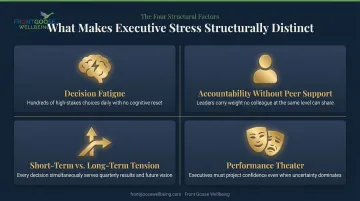
Several factors combine to create pressure loads that standard stress management advice doesn't address:
- Decision fatigue — the sheer volume and stakes of daily decisions deplete cognitive resources faster than most roles
- Accountability without peer support — executives are responsible for outcomes but often have no colleagues to process with candidly
- Short-term vs. long-term tension — constant firefighting competes with strategic thinking, creating perpetual cognitive friction
- Performance theater — the expectation to always appear composed consumes energy that would otherwise go toward actual problem-solving
The Organizational Costs
Unmanaged executive stress doesn't stay contained. Research from DDI documents a 17% drop in leadership quality ratings over two years — a measurable downstream effect of leadership burnout. When leaders are chronically stressed, decision quality degrades, team engagement drops, and turnover risk climbs.
The WHO formally recognizes burnout as an occupational syndrome characterized by exhaustion, cynicism, and reduced professional efficacy. Each of those symptoms has a direct organizational cost, and senior leaders aren't immune to them.
What Is Executive Coaching for Stress Management?
Executive coaching for stress management is a one-on-one, structured process in which a trained coach works with a leader to identify stress patterns, build personalized coping strategies, and develop the mental fitness required to perform consistently under pressure.
How It Differs From Therapy and Wellness Programs
Understanding the differences helps set realistic expectations for what coaching can — and can't — do:
| Executive Coaching | Therapy | General Wellness Programs | |
|---|---|---|---|
| Focus | Present behavior & future goals | Past experiences & clinical conditions | Group-level health habits |
| Personalization | Highly individualized | Individualized | Generalized |
| Orientation | Performance & growth | Healing & treatment | Prevention & habit |
| Scope | Role-specific leadership context | Clinical mental health | Broad well-being |
The ICF's guidance is clear: coaching focuses on present and future goals, while therapy addresses past psychological wounds and clinical conditions. A qualified coach will recognize when a client's needs exceed the coaching scope and refer appropriately.
Who Benefits Most
Executive coaching works best as a proactive investment rather than a last resort — but the entry point rarely determines the outcome. Leaders who benefit most include:
- High-performers looking to strengthen their stress response before burnout sets in
- Leaders experiencing early signs of exhaustion or cynicism who want a structured path forward
- Executives navigating major transitions — new roles, organizational change, or increased accountability
- Teams where stress-related performance issues are affecting retention or output
How Executive Coaching Addresses Stress: Core Mechanisms
Effective coaching for executive stress works through several interconnected mechanisms that together produce durable change in how a leader thinks, reacts, and leads.
Stress Identification and Self-Awareness
Most executives have normalized their stress to the point where they can no longer see it clearly from the inside. The first coaching mechanism is surfacing what's invisible.
Coaches use reflective exercises, structured questioning, and assessments — including emotional intelligence tools — to help leaders identify specific triggers, habitual reactions, and the root causes underneath them. This isn't abstract introspection. It's targeted pattern recognition that creates the foundation for every other intervention.
Emotional Regulation and Resilience Building
Coaching builds the capacity to respond rather than react — a distinction that makes a measurable difference in high-stakes situations. This involves developing self-awareness, self-regulation, and empathy: the core components of emotional intelligence.
Resilience is trainable. A 2023 meta-analysis found coaching produced significant effects on resilience (g = 0.57), psychological capital (g = 0.83), and self-efficacy. One-on-one delivery yielded the strongest effects — substantially larger than group-based resilience training.
Mindset Reframing and Growth Orientation
Chronic stress locks leaders into a threat-response mindset, narrowing the range of options they can perceive and increasing cortisol-driven reactivity. Coaches help executives shift from "this is a threat" to "this is information."
Front Goose Wellbeing's approach builds this shift through three coaching capacities:
- Mindful Awareness: staying present rather than reacting from habit
- Mindset: noticing and reframing stress-driven thoughts in real time
- Mental Rehearsal: practicing desired outcomes mentally before high-stakes situations
That last capacity has real neurological grounding. As Stanford neuroscientist Dr. James Doty notes, the brain doesn't reliably distinguish between an intensely imagined experience and a real one.
Boundary Setting and Work-Life Recovery
Recovery is a performance variable, not an afterthought. Conservation of Resources theory establishes that stress escalates when resources (time, energy, attention) are depleted without replenishment. Coaching addresses this directly by helping executives identify non-negotiable recovery practices and structure their work to protect them.
One Front Goose Wellbeing client described this outcome directly:
Megan helped me "ditch the 'always-on' mindset, and instead, focus on wellness and balance and setting healthy boundaries."
That shift — from identity ("I'm always available") to deliberate strategy — is what makes the change sustainable.
Accountability and Behavioral Change
A 1997 study found training alone increased productivity by 22.4% — but adding eight weeks of coaching increased it to 88%. The difference was accountability.
Coaching creates sustained behavioral change through regular check-ins, real-time problem-solving, and consistent progress tracking. Unlike seminars or self-help resources, coaching keeps the work alive between insights.
The Neuroscience Behind Executive Stress Coaching
The most effective coaching for executive stress is grounded in how the brain actually works under pressure — and what it takes to change it.
What Chronic Stress Does to the Brain
Chronic stress doesn't just feel bad. It changes brain structure. Research by Arnsten demonstrates that even mild uncontrollable stress rapidly impairs prefrontal cortex function — the region responsible for judgment, planning, and impulse control. Prolonged stress causes dendritic retraction in the prefrontal cortex and expansion in the amygdala, the brain's threat-detection center.
The practical result: under chronic stress, leaders literally become worse at the tasks their role demands most.
How Coaching Reverses This Through Neuroplasticity
The brain's capacity for neuroplasticity — rewiring neural pathways through repeated new behaviors — is what makes coaching-based interventions effective at a biological level.
A randomized controlled trial on mindfulness meditation found that even a three-day intensive training reduced amygdala reactivity compared to relaxation training, with changes correlating to lower cortisol levels four months later. A systematic review of mindfulness-based stress reduction for healthcare professionals similarly found MBSR effective in reducing anxiety, depression, and stress.
Front Goose Wellbeing's approach draws on this evidence base, combining Neuroleadership Institute coaching methodologies with Chopra Institute-certified meditation instruction — including Primordial Sound Meditation and breath work — to deliver mental fitness training that produces change at the neurological level, not only in outward behavior.
Mental Fitness as Cumulative Training
Practices like attention control, breath work, and mental rehearsal create cumulative neurological change — the same way physical training builds strength over time. As Front Goose frames it: "Just like with physical fitness, the more we lift weights, the stronger our muscles become. With mindfulness, we practice mental fitness, and strength train the brain."
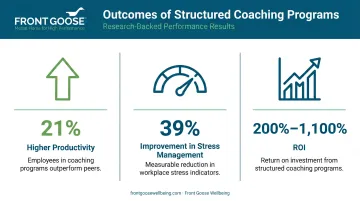
The organizational ROI case for this investment is substantial. Structured coaching programs consistently show:
- 21% higher productivity among participating employees
- 39% improvement in stress management outcomes
- 200% to 1,100% ROI documented at major corporate implementations, including Aetna and Google
What the Coaching Process Actually Looks Like
Understanding the arc of a coaching engagement helps leaders set realistic expectations and commit fully to the process.
The Engagement Structure
A typical executive coaching engagement for stress management moves through three phases:
- Assessment — Clarify current state, identify stress triggers and patterns, establish emotional intelligence baseline, and set specific goals
- Education — Build understanding of mindfulness, neuroplasticity, and how the specific techniques work and why
- Strength Training — Practice mental fitness techniques consistently, with the coach providing accountability, feedback, and real-time problem-solving
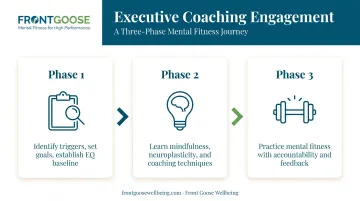
Front Goose Wellbeing follows this three-step model, with coaching grounded in the three capacities of Mindful Awareness, Mindset Reframing, and Mental Rehearsal.
What Sessions Look Like
Coaching sessions are led by the client's agenda. The coach asks structured questions to surface insights, works through specific patterns or challenges, and closes with clear behavioral commitments. Sessions are confidential — which gives executives space to be candid about pressures they can't discuss with their teams.
Session cadence varies by engagement: roughly 28% of coaches meet weekly, while 33% meet every other week. The right frequency depends on the leader's schedule and the intensity of issues being worked through.
Between-Session Practice
What happens between sessions determines whether coaching produces change or just insight. Between-session practices typically include:
- Mindfulness exercises and formal meditation
- Breathwork protocols for acute stress response
- Journaling prompts tied to session themes
- Mental rehearsal before high-stakes situations
- Behavioral experiments to test new stress responses in real conditions
Realistic Timeline
Initial shifts in self-awareness and stress response can emerge within the first few sessions. Research points to a few useful benchmarks:
- A 2023 RCT found significant reductions in all three burnout dimensions after 10 weekly sessions
- A separate meta-analysis identified 5–8 week interventions as producing the strongest mental health effects
- For durable behavioral change and measurable performance outcomes, expect a 3–6 month engagement
For leaders pursuing comprehensive development, the ICF reports an average coaching relationship of 12.8 months — a sign that the work tends to deepen over time, not wrap up quickly.
How to Choose the Right Executive Coach for Stress Management
Not all coaching is equal — and in the stress management space, the difference between a credentialed practitioner and a well-intentioned generalist matters.
Credentials to Look For
- ICF credentials (ACC, PCC, or MCC) — requiring 60–2,500+ hours of education and coaching experience depending on level, plus mentoring and credentialing exams
- NBC-HWC certification — board certification accredited by the National Board of Medical Examiners, requiring approved training and 50 documented coaching sessions
- Neuroleadership Institute training — 68 ICF-accredited hours focused on brain-based coaching methods
- Evidence of science-based grounding — coaches should be able to explain why their techniques work, not just that they do
Be cautious of coaches who rely solely on motivational frameworks or personal narrative without empirical backing.
What to Assess in an Initial Consultation
Ask direct questions:
- Do you understand the specific pressures of my role — stakeholder dynamics, performance stakes, board relationships?
- What techniques do you use, and what does the research say about their effectiveness?
- Is your process structured, or do sessions follow wherever the conversation leads?
- How do you measure progress over time?
A qualified coach answers these specifically and confidently. If you get vague answers about "being a thought partner" with no substance behind them, keep looking.
What Front Goose Wellbeing Brings to This
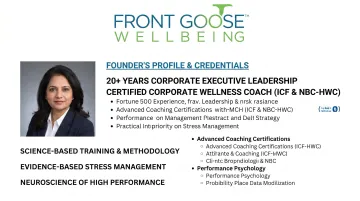
Leaders seeking a coach who has operated inside the environments they're describing — not just studied them — can explore Front Goose Wellbeing. Founder Megan Dittman spent 25+ years as an HR executive at major corporations including GE, Kohler, and Woolpert before building a coaching practice grounded in neuroscience and certified mental fitness training.
Her credentials and background include:
- Neuroleadership Institute coaching certification
- Chopra Institute Certified Meditation Instructor
- Board Certified Health & Wellness Coach (NBC-HWC), accredited by the National Board of Medical Examiners
- BBA from Notre Dame; Master's in Industrial Labor Relations from Cornell
That depth of organizational experience combined with rigorous science-based certification means the coaching reflects both how stress actually works and how large organizations actually function.
Frequently Asked Questions
What is the average cost for executive coaching?
Experienced executive coaches typically charge $300–$500+ per hour, with organizational sponsors often paying higher rates than self-paying clients. Research documenting 200–1,100% ROI from structured wellbeing programs suggests the investment compares favorably to the cost of unmanaged burnout and turnover.
What are common stress-management frameworks used in executive coaching?
Skilled coaches draw on multiple evidence-based frameworks tailored to the individual. Common approaches include cognitive reframing, Mindfulness-Based Stress Reduction (MBSR), emotional intelligence (EQ) development, Conservation of Resources theory, and the Yerkes-Dodson performance curve. No single framework works for every leader — the best coaches integrate several.
What is the 70/30 rule in executive coaching?
The 70/30 principle holds that roughly 70% of coaching value comes from the client's own reflection, application, and real-world practice, while 30% comes from the coach's guidance. It reinforces that coaching is an active process — the leader does the work; the coach provides structure and accountability.
How long does it take to see results from executive coaching for stress?
Initial self-awareness shifts can emerge within the first few sessions. A 10-week executive coaching RCT found significant burnout reductions by program end. Lasting behavioral change and measurable performance outcomes typically require a consistent 3–6 month engagement with regular between-session practice.
What's the difference between executive coaching and therapy for stress?
Therapy addresses past psychological patterns and clinical mental health conditions. Executive coaching is forward-focused and performance-oriented — working on present behaviors and future goals. A qualified coach will recognize when a client's needs fall outside coaching scope and refer them to the right professional.
Can executive coaching help prevent burnout before it happens?
Yes — proactive engagement is one of executive coaching's greatest strengths. Developing stress resilience and mental fitness before burnout strikes is more effective and less costly than rebuilding after the fact. Leaders don't need to be in crisis to benefit; high performers often see the strongest gains.