The leaders burning out aren't the ones struggling visibly. They're the ones still showing up, still delivering — but running on fumes behind a composed exterior.
Mindfulness meditation is increasingly how high-performing executives are addressing this gap. Not as a wellness trend, but as a cognitive performance tool backed by peer-reviewed research and quietly embedded in leadership development programs at GE, Ford, Salesforce, and Google. This guide covers the neuroscience, the leadership-specific benefits, practical techniques that fit a packed calendar, and how to build a practice that actually holds.
TL;DR
- Mindfulness physically changes the brain — strengthening regions that govern focus, memory, and emotional regulation
- A 2014 study published in Psychological Science found that 15 minutes of focused-breathing meditation reduced sunk-cost bias, one of the most costly errors in executive decision-making
- General Mills reported 80% of participants made clearer decisions; Aetna's program generated an estimated $3,000/employee/year in productivity gains
- Techniques like STOP, mindful breathing, and the RAIN method take under 15 minutes and require no retreat
- The biggest organizational returns come when leaders model mindfulness behaviors — creating a ripple effect on team culture and psychological safety
What Is Mindfulness Meditation for Corporate Leaders?
Mindfulness meditation is the practice of intentionally directing attention to the present moment without judgment. The practice trains where and how the mind focuses, building that capacity through repetition until it becomes automatic.
Front Goose Wellbeing defines it simply: paying attention on purpose to the breath, thoughts, sensations, or environment without judgment. The framing used with executives is "strength training for the brain" — grounded in neuroplasticity and supported by decades of neuroscience research.
Secular by Design
Modern corporate mindfulness draws from ancient traditions, but what gets delivered in boardrooms and leadership programs is secular, evidence-based, and outcome-focused. Google's Search Inside Yourself Leadership Institute (SIYLI) — now an independent nonprofit — trains leaders in emotional intelligence through mindfulness. General Mills ran a 7-week Mindful Leadership and Wellness curriculum for 123 directors and managers. Aetna built a full employee mindfulness program under CEO Mark Bertolini that produced documented health and productivity outcomes.
That track record matters most to leaders who need measurable outcomes before committing.
Why Type-A Leaders Benefit Most
Skepticism is understandable — and common. Leaders with results-driven personalities often assume mindfulness isn't for them. The evidence suggests the opposite: high-pressure environments reinforce the exact cognitive patterns that mindfulness directly counters:
- Reactive thinking — responding impulsively rather than deliberately
- Confirmation bias — filtering information to match existing assumptions
- Emotional reactivity — letting stress states drive decision-making
The more demanding the role, the higher the return on this kind of mental training.
The Neuroscience Behind Mindfulness and High-Stakes Decision-Making
The performance case for mindfulness isn't philosophical. The brain physically changes with consistent practice — and those changes directly affect how leaders think, decide, and respond under pressure.
Neuroplasticity: The Biological Basis
Holzel et al. (2011) found that an 8-week Mindfulness-Based Stress Reduction (MBSR) course was associated with increased gray matter concentration in regions tied to learning, memory, emotional regulation, and self-awareness — including the hippocampus and posterior cingulate cortex. These aren't abstract wellness benefits. They're the neural infrastructure that supports clearer thinking and steadier leadership.
Think of it like physical conditioning: the more you train focused attention, the stronger those neural networks become. Neuroplasticity means mental fitness compounds over time — and it's trainable at any career stage.
The Sunk-Cost Bias Connection
One of the most expensive decision-making errors in corporate settings is the sunk-cost bias — continuing to invest in a failing strategy because of what's already been spent. A 2014 study by Hafenbrack, Kinias, and Barsade (Psychological Science, DOI: 10.1177/0956797613503853) found that roughly 15 minutes of focused-breathing meditation measurably reduced this bias by shifting attention away from past losses toward present-moment information.
For leaders making irreversible, high-stakes decisions regularly, that's a directly applicable performance advantage.
The Amygdala-Prefrontal Loop
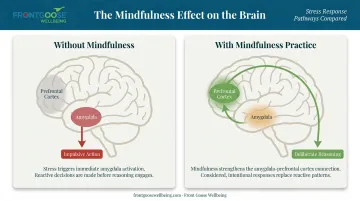
Stress activates the amygdala — the brain's threat-detection center — which narrows thinking and accelerates reactive responses. Kral et al. (2018) showed that meditation training reduces amygdala reactivity and strengthens its connection to the prefrontal cortex (the vmPFC, which governs deliberate reasoning). Doll et al. (2016) confirmed that attention-to-breath practice decreases amygdala activation during emotionally charged situations.
In practical terms, mindfulness gives leaders a neurological pause button. The reactive response still happens — it just routes through a more deliberate pathway first.
Front Goose Wellbeing's training is grounded in this science, drawing on Neuroleadership Institute frameworks to help executives understand these mechanisms and apply them under real pressure — not just in theory.
Key Benefits of Mindfulness for Corporate Leaders
Burnout Prevention
Burnout isn't a personal failure — it's a systemic risk. The World Health Organization defines it as workplace stress not successfully managed, characterized by exhaustion, cynicism, and reduced efficacy. With more than 80% of senior leaders reporting exhaustion levels in burnout risk territory, this is as much an organizational resilience issue as an individual one.
Front Goose Wellbeing's position is direct: burnout cannot be solved by EAPs, meditation apps, or fitness reimbursements. It requires intentional investment in the wellbeing of leaders — structured, ongoing, and skills-based. Better decisions start with leaders who are operating from a place of clarity rather than depletion.
Decision-Making Under Pressure
At General Mills, after a 7-week Mindful Leadership curriculum:
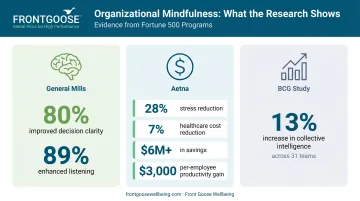
- 80% of participants reported a positive change in their ability to make better decisions with more clarity
- 89% reported enhanced listening capabilities
Mindfulness increases the gap between stimulus and response, giving leaders time to engage analytical thinking rather than reactive impulse. That same capacity — slowing down the reaction — also changes how leaders show up with their teams.
Emotional Intelligence and Team Dynamics
Self-awareness is the prerequisite for emotional intelligence. Mindfulness builds the capacity to notice one's own emotional state before it shapes a conversation — directly affecting feedback sessions, conflict resolution, and team communication.
Jack Mullen, CEO of Summer Street Advisors, put it simply after working with Front Goose Wellbeing: "Being more compassionate with myself will help me be more compassionate with my team — the human element which is so important in authentic leadership."
Focus and Cognitive Clarity
The modern leader's attention is under constant assault — notifications, back-to-back meetings, competing priorities. Aetna's workplace mindfulness program produced an estimated 62 minutes/week productivity gain per employee, valued at approximately $3,000/employee/year. Mindfulness training strengthens the brain's ability to sustain attention, filter irrelevant input, and transition cleanly between tasks.
Mindfulness Techniques Designed for the Corporate Environment
Techniques for In-the-Moment Use
The STOP Technique
Developed and documented through medical and mindfulness training contexts, STOP is a four-step micro-practice:
- Stop — pause whatever you're doing
- Take a breath — one slow, deliberate breath
- Observe — notice your thoughts, emotions, and physical state without judgment
- Proceed — re-engage with greater awareness
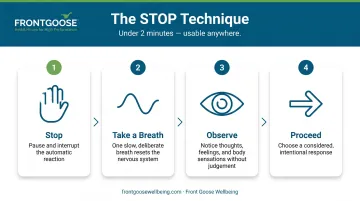
It takes under two minutes. It can be done invisibly before a difficult meeting, mid-negotiation, or after receiving unexpected news. For leaders who feel reactive in high-pressure moments, this is the simplest entry point.
Mindful Breathing Before High-Stakes Interactions
Slow, deliberate breathing activates the parasympathetic nervous system — shifting the body from fight-or-flight into a calmer, more focused state. Front Goose Wellbeing's breathwork training includes a 2:1 breathing ratio — exhale twice as long as the inhale — as a pre-meeting centering practice. Two minutes before a board presentation or performance review, it recalibrates your nervous system before you walk in the door.
The techniques above work in the moment. The ones below build the underlying capacity that makes those moments easier to navigate.
Techniques for Deeper Practice
The RAIN Method for Emotional Regulation
Originally coined by senior teacher Michele McDonald and adapted by Tara Brach, RAIN is a four-step process for working through difficult emotions rather than suppressing them:
- Recognize — name what you're feeling
- Allow — let the feeling be present without pushing it away
- Investigate — notice where it shows up in the body, what triggered it
- Nurture — respond to yourself with the same understanding you'd offer a trusted colleague
This is particularly useful for leaders navigating conflict, high-stakes feedback conversations, or organizational uncertainty. The aim is to engage with emotion clearly — so it informs your response rather than controlling it.
Formal Seated Meditation (Breath-Focused)
A basic 10-15 minute daily practice:
- Find a quiet space and sit comfortably with your spine upright
- Close your eyes or soften your gaze downward
- Bring attention to the natural rhythm of your breath — the sensation of air entering and leaving
- When the mind wanders (it will), notice and return attention to the breath without self-criticism
- Continue for 10-15 minutes
Consistency matters more than duration. Ten minutes daily outperforms 60 minutes once a week, every time.
Building a Daily Practice and Scaling It Across Your Team
Building a Personal Practice
The most common objection is time. The good news: effective practice doesn't require 30-minute blocks. Micro-practices that integrate into an existing schedule include:
- Red light breathing — 2:1 breath ratio during commute stops
- Pre-meeting centering — 60 seconds of breath focus before entering a call or room
- Mindful task transitions — a single conscious breath between switching work modes
That said, leaders who try to self-guide a practice often struggle with consistency and technique. Front Goose Wellbeing's structured corporate programs, built specifically for business leaders and executive teams, provide the instruction, accountability, and contextual framing that turns a two-week experiment into a lasting practice.
Executives like Scott Deloretta, Executive Director HR at GE Aerospace, who went through Front Goose's program, noted: "Course exceeded expectations… greater clarity and reduction in stress."
Scaling to the Team and Organization
When leaders visibly model mindfulness behaviors — pausing before responding, listening without interrupting, staying composed under pressure — teams notice and mirror those behaviors. This is the leadership ripple effect, and it's how individual practice translates into culture change.
Organizational programs can include:
- Brief team mindfulness sessions integrated into existing meeting cadences
- Mindful meeting protocols — opening meetings with 60 seconds of quiet focus to reduce distraction and improve engagement
- Instructor-led corporate programs that build collective capacity rather than leaving practice to individuals
The research backs this up. A BCG study found that a 10-week mindfulness program across 31 teams produced an average 13% increase in collective intelligence. The Aetna program produced a 28% reduction in reported stress and a 7% reduction in healthcare costs — saving over $6M. These are organizational outcomes, not just personal ones.
Frequently Asked Questions
What is corporate mindfulness?
Corporate mindfulness applies present-moment awareness and intentional attention within organizational contexts, delivered through structured programs, executive coaching, or workplace-specific daily practices. Effective corporate programs are instructor-led, evidence-based, and tied to measurable performance outcomes — not generic consumer wellness tools.
Why is mindfulness important in corporate leadership?
Leaders who practice mindfulness make better decisions under pressure, regulate emotions more effectively, and create psychologically safer team environments. Research consistently links regular mindfulness practice to improvements in decision quality, emotional intelligence, and stress resilience — making it a direct driver of both personal performance and organizational outcomes.
Which CEOs practice mindfulness meditation?
Several high-profile executives practice mindfulness publicly:
- Marc Benioff (Salesforce) — installed mindfulness zones across more than half of company offices
- Bill Ford (Ford Motor Company) — publicly stated Ford holds regular meditation and mindfulness sessions
- Mark Bertolini (Aetna) — championed a company program with documented business outcomes
- Rupert Murdoch — cited by Wharton among executives advocating for meditation
What are the 5 R's of mindfulness?
Michigan State University Extension defines the 5 R's as:
- Recognize — notice the present moment
- Relax — release physical and mental tension
- Review — observe thoughts without judgment
- Respond — act with awareness rather than react
- Return — bring attention back when it wanders
Each step helps leaders stay grounded rather than reactive under pressure.
How long does it take to see results from mindfulness as a leader?
Measurable cognitive and emotional benefits can appear within 8 weeks of consistent daily practice. Holzel et al. (2011) found structural brain changes after an 8-week MBSR course, and even 10-15 minute daily sessions show near-term improvements in focus and decision-making.