The distinction that matters most, though, is between productive challenge and chronic stress. A demanding deadline can sharpen focus and drive results. But when demands consistently outpace your capacity to meet them — with no recovery in between — the stress response stops being useful and starts doing damage.
This guide covers the neuroscience of what chronic stress actually does to the brain and body, the most common workplace causes, practical strategies individuals can use right now, and what leaders and organizations need to do structurally to address the root causes.
TL;DR
- Workplace stress occurs when job demands consistently exceed a person's capacity, resources, or control.
- Excessive workload, unclear roles, lack of autonomy, and poor communication are the most common drivers.
- Chronic stress suppresses the prefrontal cortex, impairing decision-making, memory, and emotional regulation.
- Mindfulness, deliberate boundary-setting, single-tasking, and exercise and sleep are the most effective individual interventions.
- Structured mental fitness programs deliver 20–37% productivity gains, 30–40% stress reduction, and ROI of 200–1,100%.
What Is Workplace Stress?
The NIOSH framework defines workplace stress as the harmful physical and emotional responses that occur when job demands do not match a worker's capabilities, resources, or needs. That last part — needs — is often overlooked. The real driver of stress is that gap between demand and available capacity — not the presence of challenge itself.
A stretch goal with adequate support, clear expectations, and recovery time is energizing. Chronic stress — sustained, unrelenting demand without those conditions — is damaging in ways that short-term pressure simply isn't.
Why Stress Has Intensified in Modern Workplaces
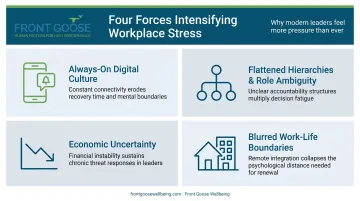
Several converging forces have made workplace stress harder to manage:
- Always-on digital culture keeps the nervous system in near-constant alert mode
- Flattened hierarchies create role ambiguity — people take on broader responsibilities without clear ownership
- Economic uncertainty raises baseline anxiety, particularly around job security
- Blurred work-life boundaries, especially post-pandemic, mean genuine recovery time has shrunk
For high performers, these pressures are often self-amplified. Demanding internal standards drive exceptional output, but they also leave little tolerance for the recovery that prevents burnout.
Common Causes of Workplace Stress
Understanding what drives stress is the precondition for managing it. Research from NIOSH and the APA consistently points to the same core stressors.
Organizational Stressors
- Excessive workload — too much work, too little time, or both
- Unclear or conflicting job expectations — employees unsure what success looks like
- Lack of autonomy — limited control over how work gets done
- Poor management communication — irregular feedback, vague direction, inconsistent expectations
- Job insecurity — fear of layoffs or organizational change
Interpersonal and Environmental Stressors
- Conflict with colleagues or managers
- Toxic team dynamics or lack of psychological safety
- Physical working conditions — excessive noise, poor ergonomics, overcrowding
- Absence of social support at work
Individual Amplifiers
Individual factors don't cause stress independently, but they shape how intensely someone experiences it. Personality type, coping style, and life demands outside work — caregiving responsibilities, financial pressure, health challenges — all affect how much stress a person can absorb before it becomes harmful. Effective programs account for this variation rather than treating stress as uniform across a workforce.
How Chronic Workplace Stress Affects the Brain and Body
The stress response is genuinely useful in short bursts. When the brain perceives a threat, the amygdala triggers a cascade of cortisol and adrenaline that sharpens immediate reactivity.
That same response simultaneously suppresses the prefrontal cortex — the brain region responsible for focus, sound judgment, emotional regulation, and complex decision-making.
For a high performer, that's not a minor inconvenience. It's a direct hit to the capabilities they depend on most.
Performance Consequences
Chronic stress doesn't just feel bad — it literally narrows thinking. Prolonged cortisol exposure:
- Impairs working memory and information retention
- Reduces creative problem-solving capacity
- Accelerates reactive, emotionally-driven responses
- Makes relationship management harder, not easier
Physical Health Consequences
The body pays a compounding price over time. Research links chronic job stress to:
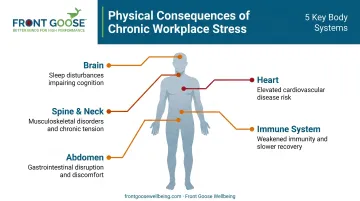
- Elevated cardiovascular disease risk
- Musculoskeletal disorders (particularly back and neck)
- Weakened immune function and slower recovery from illness
- Sleep disturbances that further impair cognitive performance
- Gastrointestinal problems
Stressed employees cost organizations measurably more in healthcare. A study published in the Journal of Occupational and Environmental Medicine found that health-related costs from absenteeism, presenteeism, and medical claims are substantially higher for high-stress workers than their low-stress peers.
Mental Health and Organizational Consequences
The physical toll is only part of the picture. Persistent stress raises the risk of anxiety, depression, and burnout — conditions that frequently go unaddressed due to workplace stigma until they become severe. In the US, the American Institute of Stress estimates that workplace stress costs employers over $300 billion annually in lost productivity, absenteeism, and healthcare expenditures.
At the organizational level, unmanaged stress drives:
- Higher absenteeism and presenteeism (showing up but not functioning well)
- Increased turnover intent, especially among top performers
- More workplace errors and accidents
- Reduced team cohesion and engagement
How Individuals Can Manage Workplace Stress
Individual strategies won't fix a dysfunctional work environment — but they build the resilience needed to function well under pressure and recover more effectively. These six approaches have meaningful evidence behind them.
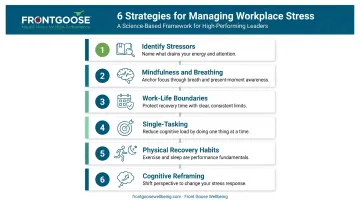
1. Identify Your Stressors First
Before managing stress, you need to understand what's actually driving it. Keep a brief stress journal for one to two weeks: note the situation, the intensity of your reaction, and any patterns you notice. This isn't a therapeutic exercise — it's diagnostic. Self-awareness creates the ability to respond deliberately rather than react automatically.
2. Practice Mindfulness and Structured Breathing
Mindfulness works because it trains the prefrontal cortex to stay engaged under pressure, directly countering the amygdala's threat response. Even a simple 3–5 minute daily practice (focused breathing or a body scan) produces neurological change over time.
Research published in NeuroImage found that regular mindfulness practice increases gray matter density in the prefrontal cortex and reduces amygdala reactivity — in other words, the brain physically changes in ways that make stress responses more manageable.
3. Set Deliberate Work-Life Boundaries
Checking email at dinner or staying mentally "on" all evening keeps the nervous system in sustained activation. There's no recovery. Practical tactics that work:
- A defined end-of-workday ritual (closing out tabs, a short walk)
- Device-free meals
- Protecting vacation time as non-negotiable
4. Shift from Multitasking to Single-Tasking
The APA's research on task-switching costs is clear: the brain loses time and accuracy every time it switches between tasks. The perceived efficiency of multitasking is an illusion — it increases cognitive load and amplifies perceived stress. Time-blocking, where you dedicate focused windows to single tasks before moving on, is a more effective alternative.
5. Build Physical Recovery Habits
Exercise, adequate sleep, and nutrition are neurological maintenance, not lifestyle extras. Three fundamentals that directly affect stress capacity:
- Exercise lowers baseline cortisol and supports hippocampal recovery
- Sleep (7–9 hours) restores emotional regulation and cognitive function
- Nutrition stabilizes the hormonal environment stress continuously disrupts
Cutting these under pressure — exactly when most people do — accelerates burnout rather than preventing it.
6. Reframe Your Internal Narrative
Cognitive reframing targets how you interpret a stressful situation, not just how you feel about it. When you catch yourself in catastrophic or all-or-nothing thinking ("This is a disaster," "I can never catch up"), actively examine whether that interpretation is accurate.
This directly engages the prefrontal cortex's capacity to modulate the amygdala's threat response, slowing the stress cascade before it escalates into a full physiological reaction.
How Organizations and Leaders Can Reduce Workplace Stress
Individual stress management tools are necessary — but insufficient when the environment itself is the problem. NIOSH is direct on this point: organizational change should take priority over individual coping programs. Asking employees to be more resilient in a poorly designed work environment is not a solution.
Address Root Causes at the Organizational Level
Leaders can make concrete structural changes:
- Set realistic workload scope and communicate priorities clearly
- Eliminate ambiguity about ownership and decision rights
- Give people control over how they accomplish their work, not just what gets done
- Make it genuinely safe to raise concerns, ask questions, or push back
- Replace top-down messaging with regular two-way check-ins
Model Recovery Culture — Don't Just Preach It
This is where many organizations fail. Megan Dittman, Founder of Front Goose Wellbeing and a 25-year Fortune 500 HR executive, frames it plainly: employees notice everything. Whether leaders take vacation, when they send emails, how they talk about work-life balance — all of it shapes team norms.
When a manager sends emails at 11 PM or checks in during PTO, the policy allowing employees to "unplug and recharge" becomes meaningless. As Dittman puts it: "You can't say one thing and do the other if you want to be credible." Leaders who model recovery behaviors — genuine downtime, boundaries, personal wellness — signal that wellbeing is actually valued.
Her experience also points to a key finding: employees who feel genuinely supported by their managers are **70% less likely to experience burnout** than those who don't.
Invest in Structured Mental Fitness Programs
Nearly half of large US companies offer some form of stress management training — but one-off workshops rarely produce lasting behavior change. The most effective programs build durable habits through ongoing practice, group learning, and accountability over time.
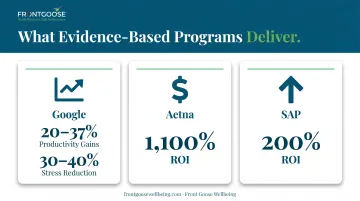
Corporate programs focused on instructor-led mindfulness training — versus meditation apps, which research shows have little measurable ROI — have demonstrated significant outcomes. Programs at companies like Google have achieved 20–37% productivity gains and 30–40% reductions in stress. Aetna's wellbeing program documented an 1,100% ROI, while SAP reported 200% ROI from similar initiatives.
Front Goose Wellbeing's programs follow this evidence-based model, combining mindful awareness, breathwork, and mental rehearsal to help teams regulate emotions and perform under pressure. Clients including GE Aerospace and Woolpert have reported measurable improvements in stress response and team performance.
Measure What Matters
Organizations serious about stress prevention track indicators before and after interventions: absenteeism rates, engagement scores, turnover intent, healthcare utilization. The WHO reports that every $1 invested in mental health treatment yields $4 in improved health and productivity — a return that makes the business case clear.
Frequently Asked Questions
What is the difference between normal work pressure and harmful workplace stress?
Pressure becomes harmful when demands consistently exceed your capacity or resources over time, with no meaningful recovery. Unlike energizing challenge — which can build capability — chronic stress degrades performance, health, and well-being cumulatively. The key distinction is sustained imbalance, not just intensity.
What are the most common signs that workplace stress is becoming a serious problem?
Early warning signs include persistent headaches, disrupted sleep, difficulty concentrating, increased irritability, emotional exhaustion, and withdrawal from colleagues. These often appear before someone consciously acknowledges they're struggling — so paying attention to physical and behavioral shifts early is worth the effort.
Can mindfulness actually reduce workplace stress, or is it just a trend?
Mindfulness has a strong scientific foundation. Regular practice physically reshapes prefrontal cortex thickness and reduces amygdala reactivity — making it a validated neurological tool, not a wellness trend. Even brief daily practice (5–10 minutes) produces measurable brain changes over weeks of consistent effort.
How can managers help employees experiencing workplace stress?
Managers should check in regularly with genuine curiosity (not just about deliverables), clarify role expectations, address workload imbalances proactively, and create space where employees feel safe raising concerns. The manager-employee relationship is one of the strongest predictors of burnout risk.
How does workplace stress affect physical health over the long term?
Chronic job stress is linked to elevated cardiovascular disease risk, musculoskeletal disorders, weakened immune function, and significantly higher rates of anxiety and depression. Healthcare costs for high-stress workers are measurably higher than for their low-stress counterparts.
When should someone seek professional support for workplace stress?
Persistent stress that disrupts sleep, relationships, or physical health — or that triggers anxiety or depression symptoms — warrants professional support. An Employee Assistance Program (EAP), health coach, or mental health professional are all appropriate starting points. Reaching out early reflects self-awareness and sound judgment.