And yet, yoga and meditation still get dismissed in executive circles. Too slow. Too soft. Not relevant to the boardroom.
That framing misses what the neuroscience actually shows. These aren't lifestyle practices — they're neurological performance tools with documented effects on cortisol regulation, brain structure, cognitive bias, and emotional regulation. The outcomes they influence are the same ones executives are already tracking: decision quality, team retention, leadership effectiveness, and performance under pressure.
This article breaks down three specific, evidence-based benefits of yoga and meditation for business executives — and what happens when those practices get skipped.
TL;DR
- Chronic stress floods the brain with cortisol, directly impairing the prefrontal cortex — the seat of rational decision-making
- Yoga and mindfulness reduce physiological stress markers and activate the body's recovery response
- Regular meditation physically changes brain structure, sharpening attention, working memory, and resistance to cognitive bias
- Both practices build emotional intelligence — the trait most consistently linked to sustained leadership effectiveness
- Studies show 13–20 minutes of daily practice over 8 weeks produces measurable results
Benefit 1: Stress Reduction — Regulating the Nervous System Under Pressure
Stress isn't just uncomfortable. For executives, it's a cognitive performance problem.
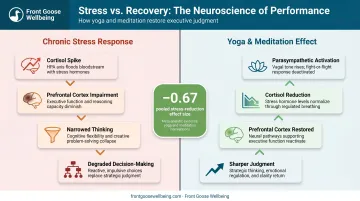
When stress becomes chronic, the body floods the system with cortisol. That triggers a fight-or-flight cascade that narrows thinking, shortens attention span, and pulls decision-making away from the prefrontal cortex — the brain region responsible for rational judgment, impulse control, and long-term planning.
As Arnsten's foundational neuroscience review explains, stress-signaling pathways structurally impair prefrontal cortex function, weakening working memory and top-down control. That means stress doesn't just feel bad. It measurably degrades the quality of executive judgment.
What Yoga and Meditation Actually Do
Yoga and meditation counteract this cascade by activating the parasympathetic nervous system — the body's rest-and-digest response. A 2017 meta-analysis of 42 randomized controlled trials found yoga-asana interventions were associated with reduced waking and evening cortisol. A separate review of workplace yoga studies across 487 employees found a pooled stress-reduction effect size of -0.67 — equivalent to a medium-to-large clinical effect.
Breathwork is particularly direct. When breath slows and deepens, the nervous system responds immediately. Front Goose Wellbeing's programs use breathwork alongside Primordial Sound Meditation — a mantra-based technique rooted in Vedic tradition — specifically because of its capacity to shift practitioners into restful awareness and quiet the mental noise that accumulates across a high-pressure day.
Why This Matters for Executives Specifically
KPIs most affected:
- Sustains decision-making consistency under sustained pressure
- Reduces absenteeism and sick leave tied to burnout
- Improves retention of senior leaders and high-performing teams
- Stabilizes performance through restructurings, M&A, and market volatility
This benefit becomes most urgent during the moments executives can least afford impaired judgment — restructurings, rapid growth phases, or external crises. Those are exactly the conditions that drive cortisol highest, and where a trained nervous system creates a measurable edge over a reactive one.
Benefit 2: Sharpened Focus and Elevated Decision-Making Quality
Focus is a competitive advantage. In an environment of constant notifications, competing priorities, and information overload, the ability to concentrate deeply on what actually matters — and sustain that concentration — is increasingly rare and increasingly valuable.
The research on this is specific and measurable.
What Happens to the Brain With Regular Practice
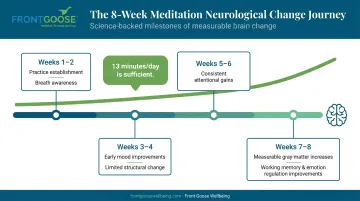
Lazar et al. (2005) found that experienced meditators showed greater cortical thickness in prefrontal regions linked to attention and self-regulation compared to non-meditating controls. More practically, Hölzel et al. (2011) showed that participants who completed just 8 weeks of Mindfulness-Based Stress Reduction (MBSR) demonstrated measurable gray-matter increases in regions governing learning, memory, emotion regulation, and perspective-taking.
Eight weeks. That's a threshold worth noting — not years of dedicated practice, but two months of consistent daily engagement.
A subsequent study found that approximately 13 minutes per day of meditation produced cognitive and mood benefits after 8 weeks, with weaker results at the 4-week mark. The brain does change, but it requires consistency over time to do so.
The Decision-Making Connection
Better attention isn't just about staying focused in meetings. It directly affects how executives process complex information under pressure:
- Hafenbrack et al. (2014) found mindfulness reduced sunk-cost bias — the tendency to commit more resources to a failing course of action — by increasing present-moment focus and reducing negative affect
- Knowledge workers showed improved task accuracy and emotional regulation after mindfulness training, even in high-stress, high-distraction environments
- Executives with stronger attentional control evaluate complex tradeoffs more clearly, without the mental fatigue that erodes decision quality later in the day
KPIs most affected:
- Decision-making speed and accuracy
- Strategic planning effectiveness
- Error rates in high-stakes choices
- Individual and team productivity output
For executives carrying multiple priorities at once, the compounding effect matters most. A sharper decision at 4 p.m. on a Thursday — when cognitive load is highest — can carry more downstream impact than any single morning strategy session.
Benefit 3: Emotional Intelligence and Leadership Presence
Emotional intelligence (EI) is often treated as a nice-to-have. The evidence suggests otherwise.
Research published in the Journal of Organizational Behavior found that EI predicts job performance and adds incremental validity beyond cognitive ability and personality factors alone. A 2023 review of 104 peer-reviewed articles concluded that emotionally intelligent leaders measurably affect team behavior, organizational culture, and business results.
Gallup's research adds another data point: managers account for at least 70% of the variance in employee engagement across business units — meaning leadership quality is a primary driver of organizational performance.
How Yoga and Meditation Build EI
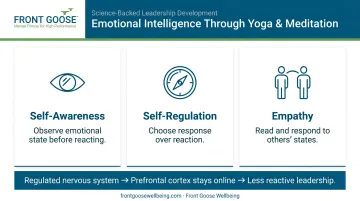
Both practices develop three core components of emotional intelligence:
- Self-awareness — the ability to observe your emotional state before reacting to it
- Self-regulation — the ability to choose your response rather than be driven by it
- Empathy — the capacity to accurately read and respond to others' emotional states
A study published in IIMB Management Review found that managers who adopted a yoga-based practice showed enhanced emotional intelligence compared to a control group. The mechanism has a clear physiological basis: when the nervous system is regulated, the prefrontal cortex stays online, and the reactive, impulsive responses that damage leadership relationships become less automatic.
What This Means in Practice
For senior leaders operating through periods of uncertainty, the ability to stay composed is a decisive differentiator. A leader who emotionally dysregulates under pressure — whether through volatility, withdrawal, or poor communication — creates ripple effects across teams. High performers notice. Engagement drops. Turnover follows.
Front Goose Wellbeing's RISE Leadership Model frames this as the Response pillar: developing leaders who maintain calm, even composure and make measured decisions even when external conditions are chaotic. Composure is a trainable skill, and yoga and meditation are among the most rigorously studied methods for building it.
KPIs most affected:
- Employee engagement and satisfaction scores
- Leadership effectiveness ratings
- Voluntary turnover on managed teams
- Conflict resolution speed
- Team performance output
What Happens When Executives Skip Mental Fitness
The cost of ignoring mental fitness at the executive level isn't just personal — it's a business risk.
Chronic stress produces decision fatigue, reactive communication, and increased error rates in exactly the situations that demand the opposite. Future Forum's 2022 research found burned-out workers reported 32% worse productivity, 60% worse ability to focus, and were 3x more likely to be job-hunting. Those numbers describe an execution risk, not a wellness problem.
The deterioration typically builds quietly, then compounds fast:
- Chronic cortisol elevation degrades prefrontal cortex function over time
- Emotional dysregulation in leadership creates toxic team dynamics and drives high-performer attrition
- Without intentional recovery practices, performance degradation accelerates and surfaces as burnout, disengagement, or leadership failure
DDI's 2025 data reinforces the retention dimension: 40% of stressed leaders had considered leaving their roles to protect their wellbeing. Losing a senior leader compounds that stress across the organization. SHRM estimates replacement costs at 50–200% of annual salary depending on level — which means proactive investment in executive mental fitness is, by any financial measure, a leadership continuity strategy.
How to Build a Sustainable Practice Without Overhauling Your Schedule
The most common objection is time. It's also the most solvable.
Research supports meaningful cognitive and stress benefits from 13–20 minutes of daily practice. Basso et al. (2019) found that 13 minutes per day produced measurable attention, memory, and mood improvements after 8 weeks. A single 20-minute mindfulness session has been shown to reduce state anxiety in high-trait-mindfulness individuals. The research doesn't require hour-long classes — it requires consistency.
That consistency doesn't require a blocked calendar. These micro-practices fit inside gaps that already exist in most executive schedules:
- Morning breathwork (5–10 minutes before the first call) activates the parasympathetic response before the day's cortisol load begins
- A 10-minute guided meditation between meetings resets attentional focus and emotional regulation
- Setting a clear intention before high-stakes conversations — a brief mindfulness practice shown to reduce reactivity and improve listening quality
- Evening Yoga Nidra or restorative practice supports recovery and sleep quality, an area Front Goose Wellbeing specifically addresses in its programs
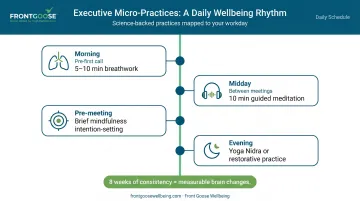
These micro-practices aren't shortcuts. They're entry points that build cumulative neurological benefit over weeks — and the evidence shows 8 weeks is enough time for measurable brain changes to occur.
Working with a qualified mental fitness coach accelerates that process. Megan Dittman, Founder & CEO of Front Goose Wellbeing, brings 25+ years of Fortune 500 HR executive experience alongside certifications from the Chopra Institute, RYT-200 yoga training, and Board Certification as a Health & Wellness Coach.
Her structured programs connect these practices directly to leadership outcomes. The RISE Executive Development retreat offers an immersive starting point for teams, while customizable corporate mindfulness programs support ongoing, organization-wide implementation.
Frequently Asked Questions
Frequently Asked Questions
Which type of yoga is best for business executives?
Styles that prioritize breath control and nervous system regulation — Hatha, Yin, Restorative, or Yoga Nidra — tend to be most beneficial for executives. The focus is on activating the parasympathetic response and building internal awareness, both of which translate directly to calmer, clearer leadership.
Can yoga help lower cortisol?
Yes. A meta-analysis of 42 randomized controlled trials found yoga-asana interventions were associated with measurably reduced waking and evening cortisol levels. Regular practice sustained over several weeks produces consistent results; isolated sessions have limited measurable impact.
How much time does a business executive need to practice daily to see results?
Research supports meaningful cognitive and stress benefits from as little as 13–20 minutes per day. Significant neurological changes — including measurable gray-matter increases in attention and regulation regions — have been observed after 8 weeks of consistent daily practice.
Is there scientific evidence that meditation improves executive decision-making?
Neuroimaging studies show meditation increases cortical thickness and gray matter in the prefrontal regions governing rational decision-making and impulse control. Research also demonstrates that meditators show reduced cognitive bias, including less susceptibility to sunk-cost errors, and stronger working memory under high-stress conditions.
Can yoga and meditation help prevent executive burnout?
Both practices directly target the physiological drivers of burnout: chronic cortisol elevation, emotional exhaustion, and degraded attentional capacity. Both are most effective as preventative tools, building resilience before burnout sets in rather than as a recovery strategy after the fact.