On-site yoga and meditation have moved well past "nice-to-have perk" territory. Neuroscience now shows these practices produce measurable changes in brain structure and function — changes that directly affect decision-making, focus, and resilience under pressure.
This guide covers what HR leaders and executives need to know: the science behind why these practices work, the program formats available, how to launch a program, what to look for in a qualified facilitator, and how to measure the return on investment.
TL;DR
- Workplace stress and disengagement cost organizations trillions — on-site yoga and meditation target root causes, not just symptoms
- Regular meditation physically rewires the prefrontal cortex, improving focus, decision-making, and emotional regulation
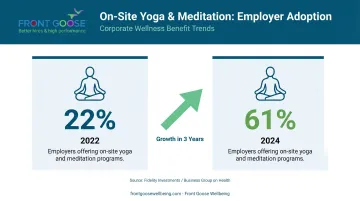
- 61% of employers planned to offer on-site yoga or meditation in 2024 — up from just 22% in 2022
- Multi-week, progressive programs outperform one-off wellness events in producing lasting behavioral change
- The most effective facilitators combine recognized credentials (RYT-200, NBC-HWC, Chopra-certified) with genuine corporate experience
Why Yoga and Meditation Fit the Modern Workplace
Corporate wellness programs span physical, mental, emotional, and financial health — but yoga and meditation address all four simultaneously. That's what makes them unusually effective as workplace interventions, and why employer adoption has accelerated sharply in recent years.
The Case for On-Site Delivery
On-site delivery removes the primary barrier to participation: friction. When employees don't have to leave the building, schedule around commutes, or find their own instruction, participation rates climb significantly. There's also something a wellness app can't replicate — shared experience.
Group sessions build team cohesion, create visible organizational commitment to wellbeing, and support habit formation in a way that self-guided apps rarely achieve. The evidence supports this: instructor-led mindfulness training produces measurable results, while self-guided app programs show little to no ROI in most organizational studies.
The Employer Trend Is Clear
A 2023 Fidelity and Business Group on Health survey found that 61% of employers planned to offer on-site yoga or meditation classes in 2024 — nearly triple the 22% who planned to do so in 2022. The message is direct: organizations that tried digital-only wellness found it wasn't enough, and they're returning to in-person, facilitated programming to get results.
The Science Behind On-Site Yoga and Meditation for Corporate Performance
These practices have a measurable, structural effect on the brain — and that's what makes them worth building into a corporate program.
What Meditation Does to the Brain
Research from Harvard (Lazar et al.) found that experienced meditators showed increased cortical thickness in the prefrontal cortex — the region of the brain responsible for decision-making, focus, and emotional regulation. This isn't a temporary state change; it's a structural one, produced through the mechanism of neuroplasticity.
Neuroplasticity means the brain physically rewires itself in response to repeated practice. As Front Goose Wellbeing founder Megan Dittman puts it: "When we train our brains to focus, we strengthen new neural connections and networks. The more we practice it, the stronger those networks become." Mental fitness works like physical fitness — repetition builds capacity.
A 2011 study on MBSR participants showed changes in gray matter concentration in brain regions involved in learning and memory, further validating the structural case for consistent practice.
How Yoga Addresses the Corporate Stress State
Most corporate employees spend their workdays in a low-grade version of the stress response — the "fight-or-flight" mode that floods the body with cortisol and narrows cognitive bandwidth. A 2020 meta-analysis of six workplace yoga trials with 487 participants found that yoga interventions conducted at worksites significantly reduced perceived stress.
Yoga activates the parasympathetic nervous system — the body's calming counterpart to fight-or-flight — enabling employees to shift out of reactive mode. That shift is where creativity and strategic thinking actually happen.
The Minimum Effective Dose
Short programs produce real effects. A Zeidan et al. study found measurable improvements in mood, working memory, and executive function after just four days of brief mindfulness training. That's not a license to run a single wellness event and call it done — but it does support the value of brief, consistent sessions as a starting point.
Why Credentials Matter for Outcomes
Consistent sessions only produce results when someone designs them with a specific outcome in mind. That requires a facilitator who understands both the neuroscience and the corporate context — not just someone who leads relaxing group stretches.
Certifications like the Chopra Institute's meditation training or Yoga Alliance's RYT pathway signal that a practitioner has been trained in evidence-based methodology. The difference shows up in outcomes: targeted cognitive and physiological improvements versus a pleasant hour that fades by Monday afternoon.
Types of On-Site Yoga and Meditation Programs
Not every format suits every organization. Here's a practical breakdown:
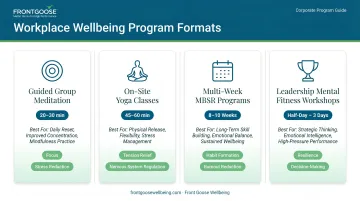
| Format | Duration | Best For | Primary Outcomes |
|---|---|---|---|
| Guided group meditation | 20–30 min | Full teams or departments | Focus, stress reduction, emotional regulation |
| On-site yoga classes | 45–60 min | Mixed groups, physically sedentary teams | Physical tension relief, nervous system regulation |
| Multi-week MBSR-style programs | 8–10 weeks | Organizations seeking behavioral change | Habit formation, sustained attention, burnout reduction |
| Leadership mental fitness workshops | Half-day to 3 days | Executive and senior leadership teams | Performance optimization, resilience, decision-making |
Guided Group Meditation
These sessions work in almost any quiet space (a conference room, a break room, even outdoors). A skilled facilitator guides participants through breathwork and focused attention practice, with sessions typically running 20–30 minutes. They're accessible to all experience levels and can be scheduled during lunch, before the workday begins, or as a mid-afternoon reset.
On-Site Yoga Classes
Where meditation addresses the mental dimension of stress, yoga handles the physical one. Corporate yoga works best in gentle or restorative styles rather than vigorous flow sequences — the goal is to address the physical effects of sedentary desk work, not add athletic challenge. Sessions of 45–60 minutes require a cleared space and basic equipment (mats, blocks). These sessions complement meditation by addressing the physical dimension of stress that meditation alone doesn't reach.
Multi-Week Progressive Programs
The standard MBSR program, developed at UMass, runs 8 weeks with weekly 2.5-hour sessions, one all-day class, and daily home practice. A 2018 workplace study of 425 employees using a comparable 10-week format found significant improvements in attention, productivity, burnout, and team cooperation.
The distinction matters: one-off sessions produce temporary awareness; structured programs build lasting skills that transfer back to the job.
Leadership Mental Fitness Workshops
These workshops are designed for high-performers and executive teams, with performance optimization as the primary focus. Front Goose Wellbeing's executive programs — including the RISE model (Response | Intention | Service | Evolution®) — integrate breathwork, meditation, neuroscience education, and mental rehearsal techniques. Leaders leave with practical tools for staying composed and decisive when it counts most.
Measurable Benefits: What These Programs Actually Deliver
Productivity and Focus
The 2018 workplace mindfulness field study showed measurable improvements in self-reported productivity and concentration. Organizations that have committed to structured programs have documented significant returns: Google has reported 20–37% productivity gains following mindfulness training, cited as a benchmark by Front Goose Wellbeing in their client materials. Those gains are most consistent when programs include trained facilitators, structured curriculum, and regular cadence — not one-off sessions.
Stress Reduction
The 2020 meta-analysis of workplace yoga trials confirmed reduced perceived stress across participants. Front Goose Wellbeing benchmarks client outcomes against a 30–40% reduction in stress — figures consistent with what structured, facilitator-led programs produce when delivered with proper curriculum design and consistency.
Return on Investment
Those productivity and stress outcomes translate directly to financial returns. The data across industries is consistent:
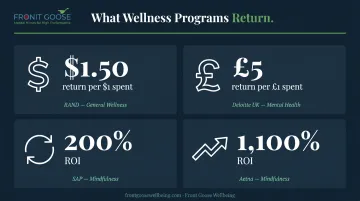
- RAND found overall workplace wellness programs return approximately $1.50 per $1 spent
- A Deloitte UK study estimated that mental health support investments return approximately £5 for every £1 spent (roughly $6 per $1 in equivalent terms)
- Corporate mindfulness programs specifically have documented returns ranging from 200% (SAP) to 1,100% (Aetna) — figures Front Goose Wellbeing references when positioning instructor-led programming against lower-cost alternatives
The inputs for ROI calculation include reduced healthcare utilization, lower absenteeism, decreased turnover, and gains in productive work hours. The outputs are most clearly measurable when organizations establish KPI baselines before a program launches.
Retention and Team Culture
Shared yoga and meditation sessions do something harder to quantify but genuinely important: they create a visible, repeated organizational signal that leadership takes employee wellbeing seriously. That signal shapes psychological safety, team trust, and retention decisions in ways that surveys consistently capture.
Employees who feel their employer invests in their wellbeing are measurably more likely to stay — and more likely to perform at a higher level while they do.
How to Launch an On-Site Yoga and Meditation Program
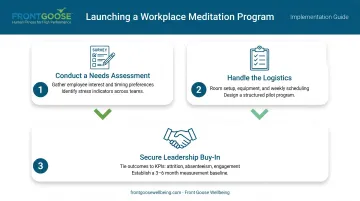
Step 1: Conduct a Needs Assessment
Survey employees before designing anything. Useful data to gather:
- Interest levels across departments and seniority levels
- Preferred session times (morning, lunch, end of day)
- Physical limitations or experience levels that will affect format selection
- Current stress indicators if available (engagement survey data, absenteeism rates)
This step prevents the most common program failure: designing for what leadership assumes employees want rather than what they'll actually use.
Step 2: Handle the Logistics
Practical requirements are simpler than most HR leaders expect:
- Meditation: Any quiet room with chairs or floor space works
- Yoga: A cleared area with enough space per participant to move freely without crowding
- Equipment: Mats, blocks, and a portable speaker for music or guided audio
- Scheduling: Start weekly rather than daily; consistency matters more than frequency in early stages
- Pilot first: Run a 4–6 week pilot with one team or department before investing in a company-wide rollout
Step 3: Secure Leadership Buy-In with Measurable Goals
Connect the program to existing business objectives — not just wellness language. Map the program to:
- Reducing attrition (and its associated replacement costs)
- Improving performance review outcomes
- Decreasing absenteeism rates
- Improving scores on engagement surveys
Define specific KPIs before launch and establish a 3–6 month baseline period so post-program comparisons are credible. That framing shifts the executive conversation from wellness initiative to business case — and that distinction determines whether the program gets funded.
What to Look for in a Corporate Yoga and Meditation Facilitator
Credentials matter more in corporate settings because executives and high performers are skeptical of soft programming. A facilitator without evidence-based qualifications and relevant business experience will lose credibility fast.
The Credentials to Look For
- RYT-200 or higher (Yoga Alliance): Foundational yoga teacher training covering technique, anatomy, and professional development — the minimum credential for yoga instruction
- Certified Meditation Instructor from an accredited program (such as the Chopra Institute): Qualifies the facilitator to teach specific techniques, including mantra-based practices like Primordial Sound Meditation
- NBC-HWC (National Board Certified Health & Wellness Coach): Accredited by the National Board of Medical Examiners, this credential ensures sessions are grounded in evidence-based behavior change methodology — not just wellness enthusiasm
Why Corporate Experience Is Non-Negotiable
A facilitator who has worked inside organizations understands performance pressure, organizational politics, and what business outcomes actually mean to a leadership team. They speak the language of productivity, attrition, and ROI rather than just relaxation and wellbeing.
Megan Dittman of Front Goose Wellbeing reflects this model directly. After 25 years as an HR executive at Fortune 500 companies including GE, Kohler, and Woolpert, she holds a Chopra-certified Meditation Instructor credential, RYT-200 yoga certification, NBC-HWC coaching accreditation, and coaching certifications from the Neuroleadership Institute.
That depth of corporate experience means her sessions connect to the goals leadership teams actually care about — not abstract relaxation, but measurable performance outcomes.
Questions to Ask a Prospective Facilitator
Before hiring, ask:
- What certifications do you hold and from which accrediting bodies?
- Have you worked with corporate or executive audiences specifically?
- Can you customize sessions to specific performance goals?
- What does a typical multi-week engagement look like?
- How do you measure outcomes before and after a program?
Frequently Asked Questions
What are the different types of corporate wellness programs?
Corporate wellness programs cover physical fitness, mental health and mindfulness (including yoga and meditation), financial wellness, nutrition, and social or employee engagement initiatives. The most effective programs address multiple dimensions at once rather than treating each category in isolation.
What are the 7 pillars of wellness?
The commonly cited pillars are physical, emotional, mental, social, financial, occupational, and spiritual/environmental. On-site yoga and meditation directly address at least three — physical, emotional, and mental, which is why they integrate naturally into any comprehensive wellness program.
How often should companies offer on-site yoga and meditation classes?
Research supports even one session per week producing measurable benefits, with twice-weekly sessions being ideal for habit formation. Consistency matters more than frequency. Start with a manageable weekly cadence and scale based on actual participation data.
What space is needed to run on-site yoga or meditation at work?
Meditation requires only a quiet room with enough chairs or clear floor space for participants. Yoga needs a cleared area with room for each person to extend their arms and legs without crowding; a conference room, lobby, or outdoor courtyard can all work with minimal setup.
Do employees need prior yoga or meditation experience to participate?
No prior experience is necessary. Corporate programs are designed for all levels, and a skilled facilitator will offer modifications and accessible entry points. Participants can expect to leave their first session with at least one technique they can apply immediately.
How do I measure the ROI of an on-site yoga and meditation program?
Track absenteeism rates, self-reported stress scores, employee engagement survey results, healthcare utilization, and productivity indicators. Establish a 3–6 month baseline before the program launches so you have credible comparison data; that baseline is what makes your results meaningful when presenting outcomes to leadership.