What matters is how leaders respond to it. A reactive stress response doesn't just affect the individual — it degrades decision quality, erodes team trust, and spreads through an organization faster than any memo. Research from Gallup shows that managers account for 70% of the variance in team engagement, which means a stressed, reactive leader is a team-performance problem, not just a personal one.
This article covers why leadership stress is physiologically distinct from ordinary workplace stress, what chronic stress actually does to the decision-making brain, which science-backed techniques create real relief, and how structured stress management coaching produces outcomes that self-directed approaches rarely achieve.
TLDR
- Leadership stress operates across four overlapping dimensions that generic wellness advice doesn't address
- Chronic stress shrinks the brain region responsible for judgment, impulse control, and strategic thinking
- Breathwork, cognitive reframing, and structured recovery rituals offer evidence-based relief — sustained results require accountability and personalized practice
- A leader's stress state is emotionally contagious, directly shaping team engagement and psychological safety
- Stress management coaching pairs personalized strategy with neuroscience-informed tools to produce measurable, lasting performance change
Why Leadership Stress Is Different — and Why It Demands a Different Response
Leadership stress isn't simply about volume. It compounds across multiple dimensions at once — and that combination is what makes it so difficult to manage without targeted support.
Four Stress Types Hitting at Once
Dr. Karl Albrecht's framework identifies four categories of workplace stress:
- Time stress — high-stakes decisions under incomplete information and tight deadlines
- Anticipatory stress — uncertainty about consequences of choices not yet made
- Situational stress — operating in environments where control is limited
- Encounter stress — absorbing and managing the heightened emotions of direct reports, boards, and stakeholders
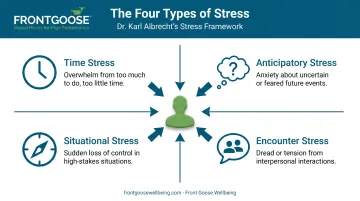
For most employees, these stressors appear individually. For leaders — especially during crises or rapid growth — all four activate simultaneously, and the expectation to project confidence while managing them adds a fifth layer entirely.
The Amplifiers No One Talks About
Several dynamics make leadership stress uniquely self-reinforcing:
- Isolation at the top — authority creates an information gap. Direct reports hesitate to share bad news, leaving leaders operating on filtered data
- Delegation anxiety — the belief that only the leader can execute correctly, which collapses recovery time
- The performance mask — the unspoken requirement to appear unshakeable regardless of internal state, which consumes enormous cognitive energy
- Stigma around overwhelm — in many organizational cultures, leaders who admit to overwhelm are still seen as incompetent
Standard wellness programs aren't built for this reality. Addressing these amplifiers requires coaching that understands the organizational dynamics leaders actually navigate — not just the stress itself.
Stress Isn't the Enemy — But the Relationship With It Is
Understanding those amplifiers points to a deeper truth: the problem isn't stress itself. The Yerkes-Dodson Law describes an inverted U-curve between arousal and performance — some stress sharpens focus, speeds processing, and elevates output. That's eustress. But when arousal exceeds an individual's optimal zone, performance collapses into decision paralysis, emotional reactivity, and eventually burnout.
The goal of stress management coaching isn't to eliminate stress. It's to help leaders recognize where they are on that curve — and to build the mental tools to stay in the zone where pressure sharpens rather than paralyzes.
What Chronic Stress Does to Your Leadership Brain
This is where the stakes become concrete. Leadership stress isn't just uncomfortable — it structurally impairs the brain functions that leaders depend on most.
The Prefrontal Cortex Problem
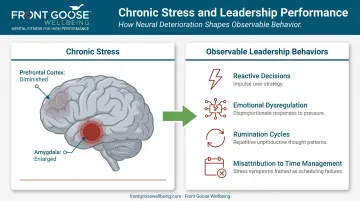
When the threat response activates, cortisol and adrenaline flood the system. Arnsten's 2009 review in Nature Reviews Neuroscience found that even mild uncontrollable stress can rapidly impair prefrontal cortex (PFC) function — the region governing judgment, impulse control, working memory, and complex decision-making. McEwen et al.'s 2016 research extended this finding: chronic stress is associated with atrophy in the PFC and hippocampus, while the amygdala (the threat-detection center) can actually enlarge.
Chronic stress makes leaders less capable of the exact thinking their roles require, while making them more reactive and threat-sensitive.
How This Shows Up in Leadership Behavior
The neurological shift translates into observable patterns:
- Decisions become reactive rather than strategic
- Emotional regulation degrades — snapping at colleagues, withdrawing from difficult conversations
- Rumination cycles consume the mental bandwidth needed for priorities
- Leaders misread this erosion as a time management problem when it's actually a stress-response problem
The Sleep Feedback Loop
A McKinsey survey of 196 business leaders found that 43% didn't get enough sleep at least four nights per week and 66% were dissatisfied with their sleep quantity. The same research notes that the prefrontal cortex is disproportionately affected by sleep deprivation, impairing problem-solving and reasoning.
The cycle is self-reinforcing: stress degrades sleep quality, poor sleep amplifies stress reactivity, and degraded performance generates new stressors — tightening the loop with each rotation.
Why There's Genuine Reason for Optimism
The brain is not fixed. A 2024 systematic review found that mindfulness and meditation are associated with measurable neuroplastic changes:
- Increased cortical thickness in regions tied to attention and self-awareness
- Reduced amygdala reactivity to stress triggers
- Improved connectivity between the amygdala and prefrontal cortex
In one study, an eight-week mindfulness-based stress reduction program strengthened the functional connection between those two regions during emotional processing. Consistent practice of science-based mental fitness techniques — breathwork, meditation, mental rehearsal — measurably rewires the neural pathways that chronic stress degrades.
Science-Backed Stress Management Techniques for Leaders
Regulate the Nervous System in Real Time
Controlled breathing is the fastest evidence-based tool for interrupting the stress response — and it requires no equipment, no time block, and no meeting cancellation.
Box breathing (inhale 4 counts, hold 4, exhale 4, hold 4) and the 4-7-8 method (inhale 4, hold 7, exhale 8) directly activate the parasympathetic nervous system by stimulating the vagus nerve. A 2022 study found that 4-7-8 breathing improved heart rate variability and blood pressure under acute stress.
These aren't soft practices. The U.S. military's Human Performance Resources program describes tactical breathing as a tool to change physical and emotional state, focus attention, and improve performance under pressure. The same tools are used by elite athletes before competition and by executives before high-stakes presentations.
When to deploy them: before board meetings, between back-to-back sessions, mid-conflict, or during any moment when reactivity is rising.
Shift Rumination to Reflection
Rumination — fixating on past events or imagined futures with negative emotional attachment — is the primary driver of leadership burnout. It is not the same as thinking about work. Research links repetitive affective rumination to burnout, degraded wellbeing, and impaired sleep.
Reflection is different: purposeful, structured review that yields actionable insight. Where rumination loops, reflection resolves.
Practical tools for shifting from rumination to reflection:
- A morning white space ritual — reviewing strategic priorities before the inbox opens
- A brief journaling protocol — externalizing mental noise converts it into clarity
- An end-of-day brain dump — offloading open loops so they stop cycling during rest time
Build Recovery Into the Architecture of Your Day
High performance requires oscillation between effort and recovery — a principle from elite athletics that rarely makes it into corporate practice. Scheduling 10-minute buffers between back-to-back meetings and enforcing digital-free wind-down periods are two practical starting points. Short breaks roughly every 90 minutes also prevent the cumulative fatigue that erodes afternoon decision quality.
A 2022 meta-analysis found that micro-breaks produced meaningful effects on reducing fatigue and sustaining vigor across workdays. The key isn't the length of the break — it's the regularity.
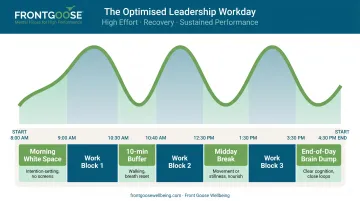
Chronic optimization without recovery looks productive — until performance degrades and burnout follows. Building in recovery is how sustained high performance actually works.
Reframe the Stressor
Recovery addresses the physical load of leadership. Reframing addresses the mental one. Cognitive reframing doesn't minimize pressure — it changes the internal relationship with it. The same missed deadline or difficult board interaction can be experienced as a threat or as a problem to be solved, depending on the narrative a leader assigns to it.
Mayo Clinic's 4 A's framework offers a practical decision structure for stress response:
- Avoid — remove the stressor where possible
- Alter — change how you engage with it
- Accept — acknowledge what cannot be controlled
- Adapt — shift your expectations or perspective
Naming the stressor clearly, separating the event from the meaning assigned to it, and redirecting attention to controllable actions are skills that can be practiced and strengthened. This is precisely what Front Goose Wellbeing's Mental Performance Coaching targets through the Mindset capacity: learning to notice thoughts and reframe them in real time.
How Stress Management Coaching Unlocks What Self-Help Can't
Most leaders can recite stress management advice. The gap isn't knowledge — it's consistent execution under pressure.
Self-directed approaches fail because they require willpower and self-awareness to deploy precisely when stress is highest and self-awareness is lowest. Research confirms that stress shifts behavior toward habitual patterns by reducing goal-directed control — meaning the brain under pressure defaults to ingrained reactions, not consciously chosen strategies.
What a Coaching Engagement Actually Looks Like
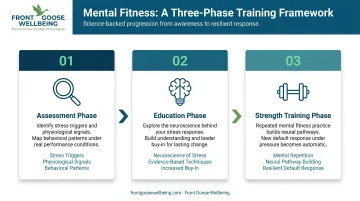
A structured stress management coaching engagement works differently from self-directed study or one-time leadership seminars:
- Assessment phase — identify individual stress triggers, physiological warning signals, and behavioral patterns specific to the leader's role and context
- Education phase — build understanding of the neuroscience behind the techniques, which increases buy-in and consistent application
- Strength training phase — practice mental fitness techniques repeatedly until they become the default response under pressure
Megan Dittman's coaching at Front Goose Wellbeing combines 25+ years of firsthand Fortune 500 HR leadership with certifications from the Neuroleadership Institute and the Chopra Institute. She's worked with organizations including GE Aerospace, Kohler, and the University of Cincinnati. A GE Aerospace executive noted the program "exceeded expectations" and delivered "greater clarity and reduction in stress." The VP of Talent at Kohler described it as the "best experience of my life."
That background — knowing how organizations actually work, paired with science-based mental fitness credentials — closes the gap that separates clinical coaching from business coaching.
The Performance ROI Case
Stress management coaching is a performance investment, not a wellness perk. The ICF Global Coaching Client Study put the median organizational ROI at 700% among companies that could supply financial figures. Key findings from that study:
- 86% of companies recovered at least the full cost of the coaching investment
- 70% of coaching clients reported improved work performance
- 72% reported improved communication skills
Front Goose Wellbeing's clients have reported 20–37% productivity gains and 30–40% reductions in stress — outcomes that show up in decision quality, retention, and team engagement, not just survey scores.
Coaching vs. Therapy — a Clear Distinction
Stress management coaching is forward-looking, performance-focused, and action-oriented — not clinical treatment for mental health conditions. It's designed for high-functioning leaders who are performing well but experiencing stress that limits their ceiling. The coaching relationship functions as a trusted sounding board, an accountability partner, and a skills trainer — filling a gap that direct reports, peers, and even close advisors cannot fill because they lack both the external perspective and the technical toolkit.
When Leaders Manage Stress, Teams and Organizations Win
The organizational impact of leader stress regulation is not abstract. Emotional contagion is real: a 2017 meta-analysis across 22,000+ individuals and nearly 5,000 groups found psychological safety positively linked to group task performance, information sharing, and learning behavior. Teams that feel safe to speak up, take risks, and admit mistakes consistently outperform those operating under chronic fear or tension.
A regulated, present leader builds that safety — a stressed, reactive leader erodes it steadily, often without realizing it.
The Cultural Cascade
When a senior leader develops genuine stress regulation capacity, it shifts the culture around them:
- Reactive crisis response gives way to proactive workload management
- Wellbeing becomes a visible performance strategy, displacing "stress as a badge of honor"
- Healthy boundaries and recovery practices become visible, giving teams implicit permission to adopt them
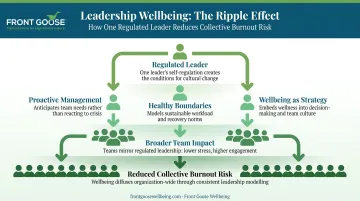
That cultural shift reduces collective burnout risk — and creates conditions where the next level of leaders develops the same capacity.
The Multiplier Effect
A single leader who manages dozens of direct reports creates a multiplier. Improved stress regulation at the leadership level compounds across teams, departments, and — over time — the entire organization.
The math is straightforward: one coached leader influences dozens. Those dozens influence hundreds. That's why stress management coaching belongs in the strategic leadership development budget, not the wellness line item.
Frequently Asked Questions
What are common stress management frameworks for leaders, like the 5 C's and 5 R's?
The 5 C's (Clarity, Control, Connection, Competence, Commitment) help leaders identify what's within their influence; the 5 R's (Recognize, Reframe, Respond, Recover, Reflect) offer a sequenced response process. Coaching helps leaders find and embed the framework that fits their specific triggers and context — not a generic framework applied across the board.
What is the 70/30 rule in coaching for leaders?
In effective coaching conversations, the client speaks roughly 70% of the time and the coach 30%, ensuring solutions emerge from the leader's own insight rather than being prescribed. This balance reinforces self-discovery and makes behavioral changes more durable than top-down advice.
What are the most effective stress management techniques for leaders?
Evidence-backed techniques include:
- Breathwork (box breathing, 4-7-8 method) for immediate nervous system regulation
- Mindfulness to interrupt rumination and restore present-moment focus
- Recovery rituals like meeting buffers and digital wind-down periods
- Cognitive reframing to shift stressors from threat to challenge
Coaching accountability determines how reliably these tools hold under real pressure.
How does a leader's stress level affect team performance?
A leader's emotional state is contagious — team members mirror their leader's stress and anxiety, which reduces psychological safety, inhibits honest communication, and drives disengagement. Gallup's research shows that managers account for 70% of the variance in team engagement, meaning a stressed, reactive leader directly undermines the performance of the people they're responsible for developing.
How is stress management coaching different from therapy or general wellness programs?
Stress management coaching is forward-looking, performance-oriented, and designed for high-functioning leaders who want to expand their capacity — not treat a clinical condition. Unlike generic wellness programs (apps, one-time workshops), coaching is personalized, ongoing, and holds the leader accountable for applying specific techniques to their actual leadership challenges, producing sustainable behavioral change rather than temporary relief.