Introduction
Workplace stress has moved from an HR concern to a boardroom problem, and the numbers make that clear. A 2025 study published in the American Journal of Preventive Medicine estimates burnout and disengagement costs U.S. employers $10,824 per manager and $20,683 per executive annually — adding up to roughly $5 million per year for a 1,000-person company.
At the same time, the APA's 2024 Work in America Survey found that 24% of U.S. workers rate their mental health as fair or poor. Employees in low-psychological-safety environments report feeling stressed at work at more than double the rate of those in high-safety environments — 61% versus 27%.
Stress is no longer an individual problem to manage on lunch breaks. For organizations, it's a strategic business risk with a measurable price tag.
With hundreds of programs now available (from AI-driven benefits platforms to science-based mental fitness coaching) choosing the right one determines whether you see real ROI or just check a benefits box. This guide breaks down five distinct, effective approaches worth evaluating in 2026.
TL;DR
- Workplace stress costs U.S. employers over $300 billion annually — the right program pays back through reduced absenteeism, stronger retention, and measurable productivity gains
- Leading 2026 programs go beyond apps — they combine evidence-based methods, manager enablement, and personalized support
- Top options span mental fitness coaching, digital therapy, AI-powered benefits, mindfulness platforms, and comprehensive EAP replacements
- Evaluate programs on evidence base, delivery format, personalization depth, measurable outcomes, and how well they support leaders
- Front Goose Wellbeing, Spring Health, Talkspace for Business, Calm Health, and Lyra Health represent five distinct approaches worth evaluating
What Makes a Workplace Stress Management Program Effective in 2026?
A workplace stress management program is a structured, evidence-based system — one that helps employees recognize stress, build coping skills, and access support while targeting the organizational conditions that generate stress in the first place: workload design, manager behavior, and culture.
The CDC/NIOSH Total Worker Health framework captures this well. It defines effective programs as those that integrate hazard protection with health promotion — treating both the work environment and the individual as targets for intervention.
The 2026 Context
Gallup's 2026 State of the Global Workplace report found that 40% of employees globally experienced significant stress the prior day — with managers reporting even higher rates at 45%. The Deloitte 2024 Gen Z and Millennial Survey found 40% of Gen Zs and 35% of millennials feel stressed all or most of the time.
Younger workers aren't looking for a meditation app buried in a benefits portal. They expect visible, meaningful action — which is exactly what separates programs that drive results from those that collect dust.
What Separates Effective Programs from Outdated Ones
The strongest 2026 programs share four characteristics:
- Evidence-based methods — cognitive behavioral approaches, mindfulness, and neuroplasticity-informed training (a 2024 RCT found mindfulness-focused internet CBT produced stress reductions with an effect size of d = 0.79)
- Personalization — programs adapted to role type, work context, and individual stress drivers
- Integration — connecting to existing benefits rather than operating as a standalone silo
- Leadership modeling — equipping managers and executives to demonstrate stress resilience, not just offer it as a resource
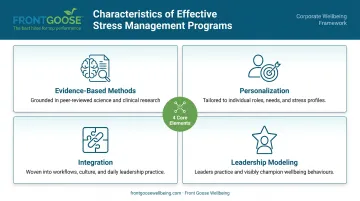
Miss two or more of these, and utilization drops — along with any measurable impact on employee health or performance.
Best Workplace Stress Management Programs in 2026
The programs below were selected based on evidence base, delivery formats, customization depth, documented outcomes, and suitability across workforce types.
Front Goose Wellbeing
Front Goose Wellbeing, founded by Megan Dittman — a former Fortune 500 HR executive with over 25 years at GE, Kohler, and Woolpert — takes a fundamentally different approach from digital-first platforms. Rather than connecting employees to therapy or app content, Front Goose delivers science-based mental fitness training that builds lasting stress resilience in leaders and teams.
The program draws on neuroplasticity principles: just as lifting weights strengthens muscles, consistent mental fitness practice strengthens neural pathways associated with focus, emotional regulation, and performance under pressure.
Megan's credentials span corporate strategy (Cornell Masters in Industrial Labor Relations, Notre Dame BBA) and certified practice, including Chopra Institute meditation, RYT-200 yoga, Neuroleadership Institute coaching, and board certification as a health and wellness coach (NBC-HWC).
What distinguishes Front Goose is the rare integration of deep HR leadership experience with certified mind-body expertise. Testimonials from clients reflect that outcome: Scott Deloretta, Executive Director HR at GE Aerospace, noted the course "exceeded expectations" with "greater clarity and reduction in stress." Maureen Allen, VP Talent at Kohler Corp., called it "the best experience of my life."
| Category | Details |
|---|---|
| Program Focus | Science-based mental fitness coaching using neuroplasticity, mindfulness, breathwork, and mental rehearsal for high-performing teams and leaders |
| Ideal For | Fortune 500 companies, executive teams, and high-performing organizations seeking measurable performance outcomes |
| Key Features | Corporate speaking engagements, team mental fitness workshops, 3-day RISE Executive Retreat, individual coaching, Primordial Sound Meditation instruction; clients include GE Aerospace, Kohler Corp, and the University of Cincinnati |
Spring Health
Spring Health is an AI-powered mental health benefits platform built for enterprise employers. Its Precision Mental Health model uses machine learning — drawing on clinical assessments, demographic data, and DSM-5 criteria — to match employees to the right level of care, whether that's self-guided tools, coaching, therapy, or psychiatry.
Spring Health has published some of the most rigorous ROI data in the category. A study published in JAMA Network Open found 1.9x ROI and $1,070 net savings per participant in year one across 13,990 participants at seven employers. A separate outcomes study covering nearly 53,000 patients found 92.3% reliably improved or recovered from depression or anxiety. Most members can access a therapist within 24–48 hours.
| Category | Details |
|---|---|
| Program Focus | AI-driven matching to individualized mental health care — coaching through psychiatry — based on clinical assessments |
| Ideal For | Enterprise employers with large, diverse workforces needing scalable, fast-access mental health benefits |
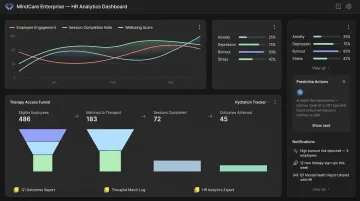
| Key Features | Precision Mental Health model, same-week therapy access, HR analytics dashboard, EAP replacement capability, global therapist network |
Talkspace for Business
Talkspace for Business functions as a high-accessibility EAP upgrade, giving employees on-demand access to licensed therapists via text, audio, and video. The asynchronous text therapy model sets it apart — employees can message their therapist any time, eliminating the scheduling friction and stigma that drive low EAP utilization.
Clinical outcomes are backed by peer-reviewed research: a 2022 JMIR Formative Research study of nearly 6,000 clients found that patients with moderate-to-severe depression scores improved below the clinical cutoff by week six. The platform also offers psychiatry and medication management through licensed providers.
| Category | Details |
|---|---|
| Program Focus | Accessible digital therapy (text, audio, video) plus psychiatry for employees managing stress, anxiety, and burnout |
| Ideal For | Employers modernizing or supplementing an existing EAP with high-accessibility, clinically backed digital therapy |
| Key Features | Text-based therapy, licensed therapist matching, psychiatric care, flexible sessions, real-time messaging between appointments |
Calm Health
Calm Health is the enterprise version of the consumer Calm app, built specifically for employers and health plans. Using PHQ-9 and GAD-7 screening, it personalizes program recommendations across burnout, grief, chronic illness, and stress — all authored by licensed psychologists.
It works best as a preventive layer, not a clinical replacement. Calm reports 93% screening completion and 53% program start rates on employer-facing pages. HR analytics dashboards provide aggregated, anonymized population data for benefits decision-making.
| Category | Details |
|---|---|
| Program Focus | Personalized mindfulness, stress management, and condition-specific mental health programs delivered through a digital app |
| Ideal For | Organizations wanting a high-engagement preventive tool that personalizes content by employee health goals and conditions |
| Key Features | PHQ-9/GAD-7 screening, personalized program recommendations, sleep and stress content library, HR analytics portal, EAP integration |
Lyra Health
Lyra Health replaces the traditional EAP model with a higher-quality, clinician-vetted approach to care. It connects employees and their dependents to rigorously vetted therapists, coaches, and mental health programs — with a Blended Care model that combines digital tools with live sessions for sustained outcomes.
The independent employer data is compelling: Aon research found approximately $2,300 lower claims costs per participant per year and roughly 26% lower healthcare claims costs among Lyra users. The platform is available to 20M+ people globally, supports dependent coverage up to age 26, and Lyra has published 20 peer-reviewed studies as of 2025.
| Category | Details |
|---|---|
| Program Focus | Comprehensive mental health benefits combining coaching, therapy, medication management, and digital tools for employees and families |
| Ideal For | Mid-to-large employers replacing legacy EAPs with a higher-quality, evidence-based mental health benefits model |
| Key Features | Evidence-based provider network, Blended Care model, dependent coverage, real-time outcome reporting, global access |
How to Choose the Right Program
Most organizations pick a stress management program based on vendor reputation or budget — then wonder why utilization stalls at 8%. The real issue is fit: matching the program type to how your workforce actually operates and what outcomes you're trying to move.
The Five-Criteria Framework
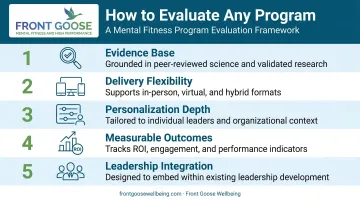
Evaluate any program against these dimensions:
- Evidence base: Does it use scientifically validated methods? Look for CBT, mindfulness research, and neuroscience-informed design — not just a content library
- Delivery flexibility — Can it serve hybrid, remote, and in-person teams without friction?
- Personalization depth — Does it adapt to role-specific stressors, or is it one-size-fits-all?
- Measurable outcomes: Can the provider show ROI through absenteeism, productivity, or retention data? Ask for independent validation, not self-reported metrics
- Leadership integration — Does the program equip managers and executives to model stress resilience? Programs that skip this step rarely drive cultural change
Matching Program Type to Organizational Need
| Need | Recommended Program |
|---|---|
| Executive and leadership performance (coaching-based) | Front Goose Wellbeing |
| Fast clinical access at enterprise scale | Spring Health |
| Stigma reduction and accessibility | Talkspace for Business |
| Preventive, population-level engagement | Calm Health |
| Full EAP replacement with dependent coverage | Lyra Health |
Note that coaching-based programs like Front Goose Wellbeing operate differently from clinical platforms — they focus on building mental fitness and resilience skills in leaders and teams, rather than providing therapy or EAP services. The strongest wellbeing strategies often combine both: clinical access for acute needs and skills-based training for sustained performance.
Conclusion
In 2026, the most effective workplace stress management programs are grounded in science, built for specific workforces, and designed to produce measurable outcomes. Whether your organization needs scalable digital tools, on-demand clinical care, or personalized mental fitness coaching, the right fit starts with a clear-eyed look at what's actually driving stress in your environment.
Before committing, test any program against evidence quality, utilization data, and ROI track record. Ensure leadership actively models the culture the program is meant to build.
Organizations looking to develop mental fitness at the leadership and team level through a science-backed, personalized approach can connect with Megan Dittman at Front Goose Wellbeing to explore what a corporate mental fitness program could look like for their team.
Frequently Asked Questions
What is the 3-3-3 rule for stress management?
The 3-3-3 rule is a grounding technique where you identify 3 things you can see, 3 sounds you can hear, and move 3 parts of your body. As documented by Cleveland Clinic, it redirects attention to present sensory experience, interrupting the stress response. It's widely incorporated into workplace mindfulness training as a quick, accessible reset.
What is the 42% rule for burnout?
The "42% rule" circulates informally in wellness discussions but lacks validation from Gallup, APA, or NIOSH. More reliable benchmarks for employers include the AJPM 2025 burnout cost study and Gallup's 2026 finding that 40% of employees globally reported significant stress the prior day.
What are the top workplace wellness trends in 2026?
Key trends include the shift from passive wellness perks to strategic well-being investment, AI-driven personalization in mental health benefits, science-based mental fitness training for leaders, integrated benefits ecosystems with real-time analytics, and heightened focus on economic and AI-related workplace anxiety identified in Mercer's 2026 Inside Employees' Minds survey.
What are the 5 C's of stress management?
The 5 C's appear across multiple frameworks; the documented version from Positive Youth Development research includes Competence, Confidence, Character, Connection, and Caring. Some coaching models adapt this for workplace stress support, but no single standardized occupational health framework uses this name. If a vendor references it, ask for the source.
What is the difference between an EAP and a stress management program?
EAPs are typically reactive: short-term counseling resources available during a crisis. Stress management programs are proactive: structured initiatives that build coping skills, address organizational stressors, and include coaching, workshops, and mindfulness training. EAPs treat problems after they surface; stress management programs are designed to prevent them.
How do you measure the ROI of a workplace stress management program?
ROI is measured through reductions in absenteeism, improved self-reported stress and engagement scores, lower healthcare utilization costs, and productivity gains. Leading platforms — Spring Health, Lyra Health, and Calm Health among them — provide HR analytics dashboards that track these metrics at the population level, making it possible to compare pre- and post-program performance over time.