Introduction
Most organizations already have wellness programs. Gym subsidies, step challenges, mental health app subscriptions — the infrastructure exists. Yet depression and anxiety cost the global economy $1 trillion per year in lost productivity, according to the WHO. Burnout rates haven't dropped. Disengagement keeps climbing.
So if wellness programs are everywhere, why aren't they moving the needle?
The answer points to a different kind of investment. Human skills training — building employees' capacity to regulate stress, focus under pressure, and navigate high-stakes situations with emotional control — is the category most wellness programs skip entirely.
This article clarifies what corporate wellness training means in practice, why mental fitness is the gap most programs skip, and what effective programs look like when they're built to drive real performance outcomes.
TL;DR
- Corporate wellness has shifted from physical perks to strategic investment in mental fitness and human skills.
- The highest-impact programs build trainable capacities like resilience, emotional regulation, and stress management — not just expand benefit access.
- Effective programs require leadership participation, science-backed methods, and sustained practice over time.
- Organizations that invest in human skills training report productivity gains of 20–37% and ROI ranging from 200% to over 1,000%.
What Is Corporate Wellness Training Today?
Corporate wellness training refers to structured, skills-building programs that improve employees' physical, mental, emotional, social, and financial well-being. The key word is structured. This is distinct from wellness benefits — the gym memberships, EAP hotlines, and meditation apps that organizations offer but employees rarely use consistently.
Research shows users abandon behavioral health digital tools — including meditation and relaxation apps — within two weeks of downloading them. Benefits provide access. Training builds the capability to actually use it.
The Major Categories
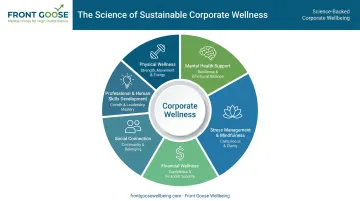
The corporate wellness landscape covers six recognized domains:
- Physical wellness — fitness, nutrition, ergonomics
- Mental health support — EAPs, counseling access, crisis resources
- Stress management and mindfulness — structured programs to build coping capacity
- Financial wellness — education on financial planning and security
- Social connection — programs that strengthen team cohesion and belonging
- Professional and human skills development — training employees in resilience, emotional regulation, focus, and communication
That last category is consistently the most undertapped. SHRM found that 89% of organizations offered mental health coverage in 2023, yet 59% of U.S. workers said their employer still didn't provide enough mental health resources. Coverage is not the same as capability-building.
From Perks to Practice
Organizations that treat wellness as a checklist — add a benefit, announce it, move on — see low engagement and no measurable outcome. The ones getting results have moved from offering access to building practice. That gap shows up most sharply in the human skills category: telling employees they can use a meditation app is not the same as training them to regulate stress responses in real time.
The Human Skills Gap: Why Mental Fitness Is the Missing Piece
What Human Skills Actually Are
Human skills in a workplace context include:
- Resilience — recovering from setbacks without prolonged disruption
- Emotional regulation — managing reactions under pressure
- Stress management — recognizing triggers and interrupting the stress cycle
- Focus and attention — sustaining concentration in high-demand environments
- Empathy and communication — reading situations accurately and responding constructively
- Psychological flexibility — adapting thinking when circumstances change
The American Psychological Association is clear that resilience is not a fixed personality trait — it involves behaviors, thoughts, and actions that can be learned and developed. A 2021 scoping review identified 48 organizational resilience-training studies, confirming that these are trainable capacities, not innate characteristics.
This is where neuroscience matters. The brain forms and strengthens neural connections through repeated practice — neuroplasticity. Just as physical training builds muscle through repetition, mental fitness training builds cognitive and emotional capacity through consistent, focused practice.
The Gap Between Support and Skill-Building
Most corporate wellness programs offer reactive support: EAP hotlines employees call after reaching a breaking point, counseling access, or crisis resources. These are necessary — but they're not sufficient.
What's missing is proactive skill-building — training that develops employees' capacity before they're overwhelmed, not after. Mental health support addresses crises; mental fitness training builds the capacity to handle pressure before it becomes one.
The distinction matters the same way injury treatment differs from strength training. You wouldn't skip the gym and rely entirely on physical therapy.
The Leadership Multiplier
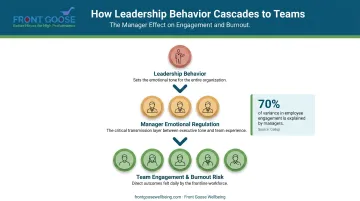
That skill-building gap matters most at the top. Gallup estimates managers account for at least 70% of variance in employee engagement scores — meaning when leaders lack emotional regulation skills, that deficit doesn't stay contained. It cascades.
Teams notice when a manager sends emails at 11 p.m., responds to setbacks with reactive frustration, or is visibly overwhelmed. Employees who feel unsupported by their manager are significantly more likely to experience burnout.
This is why human skills training is especially critical at the leadership level. When executives develop these capacities, the effect multiplies across the entire organization.
What Human Skills Wellness Training Looks Like in Practice
Mindfulness and Meditation-Based Training
Structured mindfulness training does more than promote relaxation. The mechanism is neurological: consistent practice reduces cortisol responses, strengthens prefrontal cortex function, and improves attention and working memory.
A workplace randomized controlled trial found that high-dose mindfulness training reduced perceived and momentary stress and buffered employees against worsened affect and reduced coping capacity. These are performance metrics, not wellness peripherals.
Effective corporate mindfulness programs include guided meditation sessions, breathwork techniques, and mental rehearsal frameworks employees can apply during actual work situations: preparing for a high-stakes presentation, navigating a difficult conversation, or recovering focus after an interruption.
Front Goose Wellbeing's corporate mindfulness programs are built around four components — mindful awareness, breathwork, meditation, and mental rehearsal — grounded in neuroplasticity science.
The approach draws on traditions including Primordial Sound Meditation and Vipassana, framed for business audiences through neuroscience rather than spirituality. The analogy Megan Dittman uses is straightforward: physical training builds muscle through repetition; mental fitness training builds neural strength the same way.
Resilience and Stress Regulation Training
Resilience training teaches employees to recognize stress triggers, reframe challenges, and build recovery habits. A single session can introduce these concepts. Lasting behavioral change requires something different.
Habit formation science is clear: durable change needs repetition in consistent contexts. Programs that embed structured follow-through outperform one-time awareness events because they build the repetition required for new behaviors to stick. Effective sustained programs typically include:
- Brief daily practices employees can maintain between sessions
- Follow-up coaching to reinforce and personalize concepts
- Peer accountability structures that sustain momentum over time
Emotional Intelligence and Communication Skills
Communication workshops consistently rank among the highest-ROI team-level interventions in corporate wellness. The reason is direct: friction in teams is expensive. Miscommunication, unresolved conflict, and poor feedback loops reduce collaboration efficiency and increase turnover risk.
EQ-focused training builds self-awareness, empathy, active listening, and the ability to navigate conflict constructively. These aren't soft outcomes — they translate directly to reduced management overhead, faster decision-making, and stronger team cohesion.
Client feedback from Front Goose Wellbeing's programs reflects this. Leaders report gaining tools to "authentically connect with and coach team members," and teams describe the training as creating "a healthier and more productive environment."

Focus and Cognitive Performance Training
Megan Dittman's programs at Front Goose Wellbeing draw on Neuroleadership Institute coaching methodologies alongside Chopra Institute meditation training to help business leaders build what she describes as laser focus and emotional control — treated as direct performance tools, not supplementary wellness content.
GE Aerospace's VP Fernando Almeida described the program as doing "a fantastic job bringing science and practice together in the form of tools to focus on mindfulness, reduce stress and improve performance."
Programs are tailored by audience: the approach for a C-suite executive cohort differs from a frontline team training. Delivery formats include group workshops, 1:1 coaching, speaking engagements, and the RISE Executive Leadership Retreat.
What Makes Corporate Wellness Training Programs Actually Work
Leadership Commitment
The CDC is explicit: effective workplace health programs require senior leaders to act as visible role models and champions. When wellness training is positioned as an HR initiative employees can opt into, participation is low and cultural adoption is minimal.
Adoption rates improve when executives participate alongside their teams and visibly model the behaviors they're practicing. Kohler's VP of Talent described Front Goose Wellbeing's program as "life shifting" — that kind of senior-level endorsement signals organizational priority, not just personal benefit.
"Life shifting." — Kohler VP of Talent, on Front Goose Wellbeing's program
Sustained Practice Over One-Off Events
Neuroscience on habit formation is consistent: behavior change requires repeated enactment in a consistent context until new patterns become automatic. A single-day workshop may create awareness, but it rarely builds lasting capability.
Effective programs address this by embedding ongoing practice structures:
- Follow-up group coaching sessions that process and reinforce concepts
- Daily micro-practices employees can realistically maintain
- Accountability structures that keep momentum between sessions
Front Goose Wellbeing's approach explicitly tackles the "Forgetting Curve" — research shows that without reinforcing activities, roughly 90% of new skills are lost within a year.
Measurement and Refinement
Organizations that track outcomes can prove ROI and improve programs. Key metrics worth monitoring include:
- Self-reported stress levels (pre/post program surveys)
- Participation and engagement rates
- Absenteeism trends
- Productivity indicators by team
- Retention rates across program cohorts
The goal is measuring outcomes, not just activity. Tracking whether 200 employees attended a session is not the same as tracking whether stress-related absenteeism declined.
The ROI of Human Skills Wellness Training
The Financial Case
Deloitte's UK research found an average £5 return for every £1 spent on workplace mental health and wellbeing interventions — a ratio consistent with what US employers report across absenteeism reduction, lower turnover, and productivity gains.
Industry benchmarks from major corporate mindfulness programs show the range of what's achievable:
| Organization | Reported Outcome |
|---|---|
| 20–37% productivity gains, 30–40% reduced stress | |
| Aetna | 1,100% ROI |
| General Motors | 700% ROI |
| SAP | 200% ROI |
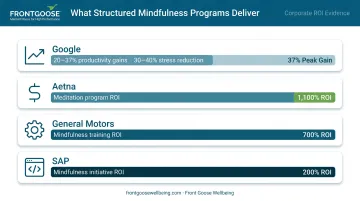
These figures represent instructor-led, structured programs — not app subscriptions or one-time workshops.
Talent Attraction and Retention
81% of workers said employer mental health support would be an important factor when evaluating future employment, according to APA's 2022 report. Among workers fully aware of their employer's mental health benefits, retention likelihood was 10 percentage points higher than among those who weren't.
That gap matters. Organizations that communicate and deliver strong human skills programs have a measurable edge in both attracting and keeping talent.
Addressing the Cost Concern
Human skills training doesn't require physical infrastructure. There are no facilities to build, no equipment to maintain. Well-structured programs delivered by specialist providers are scalable across organizations of varying sizes.
Working with an external specialist keeps the investment accessible — no internal capability to build from scratch. Key cost advantages include:
- No facility or equipment overhead
- Programs scale to team size and leadership level
- Customizable scope means cost aligns with organizational goals
- Faster deployment than building an in-house function
Frequently Asked Questions
What are the 7 pillars of wellness?
The seven pillars are physical, mental, emotional, social, financial, spiritual, and environmental (or occupational, depending on the framework). Effective corporate wellness training addresses multiple pillars simultaneously — not just physical health — to drive meaningful and lasting outcomes.
What is the average cost of a corporate wellness program?
Costs vary widely based on program scope, delivery format, and whether organizations use in-house resources or specialist providers. No current authoritative public source provides a reliable universal per-employee average. Organizations should evaluate cost relative to program design, expected outcomes, and measurement requirements rather than comparing headline figures.
What is the difference between corporate wellness benefits and wellness training?
Wellness benefits are passive — gym subsidies, EAP access, and health apps employees can choose to use. Wellness training is active and structured, building specific capabilities like resilience, focus, and stress regulation that employees carry into their daily work. Benefits make resources available; training builds the skills to use them.
How do human skills programs help reduce burnout?
Human skills training addresses burnout at its root by building employees' capacity to regulate stress responses, recover from high-pressure situations, and set cognitive boundaries — before they reach a breaking point.
How long does it take to see results from corporate wellness training?
Self-reported improvements in stress and mood can appear within weeks of structured mindfulness or resilience training. Deeper behavioral and cultural shifts typically emerge over three to six months of sustained engagement. One-time workshops produce limited retention; ongoing practice drives lasting outcomes.