Introduction
Most leadership teams today are built from highly capable individuals — and still struggle to function as a unit. The pace of organizational change has accelerated dramatically: McKinsey reports the average employee now experiences ten planned enterprise changes per year, a fivefold increase from a decade ago. That's pressure senior leaders absorb directly — and can't absorb alone.
Peter Hawkins' Leadership Team Coaching: Developing Collective Transformational Leadership frames the diagnosis clearly: the challenges organizations face have outgrown what any single leader can navigate. Developing the team itself as a leadership entity is the response that actually scales.
Collective transformational leadership is the capacity of a leadership team to think, act, and lead together — producing outcomes no individual member could achieve alone. This guide covers Hawkins' Five Disciplines framework, a practical stage-by-stage development roadmap, and the mental fitness foundation that determines whether collective leadership takes hold — or erodes the moment pressure hits.
TL;DR
- Collective leadership treats the team — not the individual — as the primary unit of leadership
- 75% of cross-functional teams are dysfunctional, making intentional development essential
- Hawkins' Five Disciplines (Commissioning, Clarifying, Co-Creating, Connecting, Core Learning) provide a holistic development framework
- Psychological safety is the foundation every other collective development practice depends on
- Individual mental fitness determines whether leaders can genuinely show up for the collective
What Is Collective Transformational Leadership?
The dominant leadership model for most of the 20th century was essentially heroic: one exceptional individual sets the vision, makes the calls, and drives the results. Complex, fast-moving organizations have outgrown that model. They need distributed intelligence and shared accountability, not a single point of authority.
Collective transformational leadership reframes leadership as a function of the team, not any individual within it. The team becomes a unified system capable of strategic agility, culture change, and adaptive decision-making that no single leader, however talented, can sustain alone.
A Group of Leaders ≠ A Leadership Collective
This is where many organizations get stuck. Assembling strong individuals does not produce a strong team. High-caliber leaders often default to:
- Protecting their functional territory instead of optimizing for the whole
- Avoiding conflict to preserve relationships, sacrificing honest dialogue in the process
- Running parallel tracks rather than genuinely collaborating
- Owning their silo's results, not shared outcomes
The result is a leadership group that looks unified in presentations but operates as a collection of individual agendas behind closed doors.
This approach is also distinct from team building or group coaching. It's a sustained, structured development process that treats the team as a living system — one with its own culture, internal dynamics, and influence on the organization it leads. That systemic perspective is what separates it from a one-time offsite or a series of workshops.
Why Individual Leadership Is No Longer Enough
The data is direct: 75% of cross-functional teams are dysfunctional by most key effectiveness measures. And the cost of leadership team misalignment isn't just internal friction — it hits financial performance. McKinsey found that organizations with aligned, effective top teams are nearly twice as likely to achieve above-median financial performance.
The Failure Modes of High-Caliber Teams
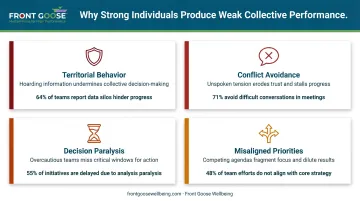
Strong individual leaders frequently produce weak collective performance through predictable patterns:
- Territorial behavior — optimizing for their function over the enterprise
- Conflict avoidance — surface harmony that masks unresolved disagreement
- Decision paralysis — slow or unclear accountability at the top creates bottlenecks throughout the organization
- Misaligned priorities — McKinsey reports that only 60% of leadership teams are actually aligned on organizational purpose, despite rating it as critical
Individual excellence does not transfer automatically to collective effectiveness. Sustaining a genuine culture shift or a major strategic pivot requires the team to think, decide, and move as one — and that collective capability must be built with intention.
The Five Disciplines of Collective Transformational Leadership
Peter Hawkins' Five Disciplines model, developed across multiple editions of Leadership Team Coaching, provides the most comprehensive framework available for building collective leadership. Its power lies in being holistic: it addresses both the team's internal dynamics and its outward relationship with the organization and stakeholders it serves.
The five disciplines are Commissioning, Clarifying, Co-Creating, Connecting, and Core Learning.
Commissioning
Commissioning answers the team's foundational question: Why does this team exist? It establishes the mandate from the broader organization, clarifies what success looks like from a stakeholder perspective, and ensures the team's priorities are genuinely aligned with organizational purpose — not just internally coherent.
Without this anchor, even high-functioning teams drift from what the organization actually needs them to do — productive internally, misaligned externally.
Clarifying
Clarifying produces the operational scaffolding: shared purpose, defined roles, measurable goals, and team agreements — the full set of commitments that keep execution on track. Ambiguity here is surprisingly common and disproportionately damaging. Unclear roles and undefined success metrics create friction that undermines everything built afterward.
Co-Creating
Co-Creating develops the working relationships inside the team: trust, psychological safety, constructive conflict, and collaborative decision-making. Most leadership development stops here — and that's precisely the limitation. Co-Creating is one of five disciplines, not the whole picture.
Connecting
Connecting is the outward discipline. It addresses how the team engages with critical stakeholders — internal and external — and whether team members share a genuine collective understanding of who they serve and why.
A team can be beautifully cohesive internally and still fail its organizational mandate by neglecting the relationships and systems around it.
Core Learning
Core Learning sustains the other four. Through regular cycles of reflection, feedback, and adaptation, the team builds collective capacity over time — rather than plateauing after an initial development push. Without it, gains from earlier disciplines erode as the organization shifts and new pressures emerge.
A note on sequencing: these disciplines are not a linear checklist. The right entry point depends on where the team is struggling most:
- Drifting from organizational priorities? Start with Commissioning.
- Role confusion or misaligned goals? Begin at Clarifying.
- Interpersonal friction blocking execution? Co-Creating is the priority.
- Stakeholder relationships fraying? Move to Connecting first.
- Gains not holding over time? Core Learning needs attention.
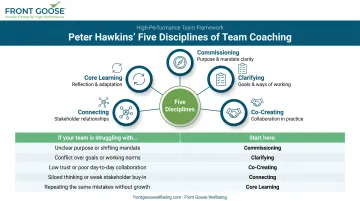
Diagnosing the right starting point — rather than working through all five sequentially — is often what separates a productive team coaching engagement from one that stalls.
How to Develop Collective Transformational Leadership: A Stage-by-Stage Approach
Effective collective leadership development unfolds through structured phases over months — not a single offsite or workshop. McKinsey notes that building top-team performance can happen "well within a year" when senior teams combine structured work with real business practice and sustained behavior change. The key word is sustained.
Contracting and Diagnosis
Before any development work begins, establish clear goals and success measures with both the team leader and members. Conduct individual interviews or diagnostic assessments to surface the current state: where is the team effective, where is it fragmented, what are the unspoken tensions?
This phase prevents the most common mistake in team development — jumping to solutions before understanding the actual problem.
Building Psychological Safety and Trust
Amy Edmondson's foundational research defines psychological safety as a shared belief that the team is safe for interpersonal risk-taking. Google's Project Aristotle identified it as the single most important factor in team effectiveness — more predictive than talent, structure, or prior experience.
Without psychological safety, no real collective development is possible. Leaders default to self-protection and honest dialogue goes underground. A coach's role here is to surface unspoken tensions, establish new behavioral norms, and help the team leader model the vulnerability that makes safety real.
Aligning Strategy and Accountability
Once trust and communication stabilize, the team shifts to shared strategic priorities, clear accountability structures, and decision-making protocols. This is where the collective's ability to navigate organizational complexity becomes visible. McKinsey data shows teams 1.9x more likely to achieve strong financial performance when aligned around a common vision.
Embedding Learning and Handing Off
The final phase transitions from coach-led reflection to team-owned learning. The measure of success: can the team sustain honest inquiry, productive challenge, and strategic alignment without external facilitation?
Mechanisms that support this transition include:
- Peer coaching pairs — structured accountability between team members between formal sessions
- Periodic structured reviews — regular team retrospectives on decisions, not just outcomes
- Shared behavioral norms — explicit agreements the team revisits and updates over time
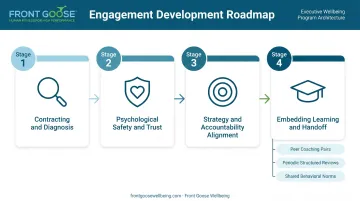
Throughout all phases, the team leader's behavior is determinative. Their willingness to share authority and receive feedback directly shapes what's possible for the team. A skilled coach helps the leader make that shift concrete — moving from the person who holds all the answers to the person who creates the conditions for others to lead.
The Mental Fitness Foundation: Why Mindset Determines Collective Leadership Success
Structural frameworks and coaching processes are necessary — but not sufficient. What determines whether collective leadership actually holds under pressure is the inner capacity of each individual leader.
The Neuroscience Case
Arnsten's research in Nature Reviews Neuroscience shows that stress signaling pathways directly impair prefrontal cortex structure and function — the region responsible for executive judgment, perspective-taking, and collaborative decision-making. When leaders are chronically stressed, their capacity for the exact cognitive functions collective leadership requires is neurologically compromised.
David Rock's SCARF model from the NeuroLeadership Institute adds another layer: leadership team dynamics constantly activate threat and reward responses around Status, Certainty, Autonomy, Relatedness, and Fairness. Leaders who can't regulate these responses don't just underperform individually — they destabilize the collective.
What Mental Fitness Training Delivers
The research on mindfulness-based interventions in leadership contexts shows consistent effects on the capabilities collective leadership demands:
- Improved emotional regulation and reduced stress reactivity
- Stronger working memory and cognitive flexibility under pressure
- Greater capacity for perspective-taking and empathy
- Sustained attention and focused decision-making
When mental fitness is absent from the development process, leaders may understand the principles of collective leadership intellectually but revert to territorial, avoidant, or reactive behavior the moment organizational pressure rises. The relational work done in coaching sessions erodes when the hard conversations happen back in the real world.
Front Goose Wellbeing's Approach
The most effective organizations pair structural coaching with dedicated mental fitness training. Front Goose Wellbeing, founded by Megan Dittman — a Chopra Institute-certified meditation instructor, Neuroleadership Institute-trained coach, and former Fortune 500 HR executive with 25+ years at companies including GE and Kohler — delivers precisely this inner foundation work.
The RISE model (Response | Intention | Service | Evolution) provides a structured framework for developing leaders who can stay present under pressure, act from authentic purpose, lead with empathy, and remain open to growth. Programs include mindfulness training, breathwork, mental rehearsal, and science-based meditation modalities — all designed to build the neural resilience that collective leadership depends on. These are available as standalone corporate training programs or integrated into multi-day executive retreats, customized to the organization's specific development goals.

Common Pitfalls and How to Avoid Them
Treating It as a One-Off Event
A single retreat or workshop cannot rewire collective habits. Leadership team coaching requires sustained engagement: assessment, coaching sessions, real business practice, and structured reflection over time. HBR research on why leadership training fails identifies a clear culprit: people revert to old behaviors when the organizational system around them doesn't support change.
That means upfront commitment to sustained engagement isn't optional — it's the foundation everything else builds on.
Focusing Only on Internal Dynamics
Teams that invest heavily in Co-Creating — building trust and relational cohesion — while neglecting Commissioning and Connecting risk becoming a tightly bonded group that loses sight of what they collectively serve.
McKinsey data shows 58% of CEOs identify external stakeholder relationships as a top priority, yet only 12% feel successful managing them. Coaches and leaders should continuously connect internal development work to external impact and organizational purpose.
Ignoring Root Causes
Poor communication and conflict avoidance are symptoms, not causes. They usually signal deeper structural misalignment — unclear strategy, ambiguous accountability, or unresolved disagreement about organizational direction. BCG analysis found that roughly 70% of transformations fail to reach initial objectives, often because teams address surface behaviors while leaving underlying causes intact.
Effective collective leadership development means going beneath the surface. Common root causes worth examining include:
- Unclear or contested organizational strategy
- Ambiguous ownership of key decisions
- Unresolved interpersonal conflict among senior leaders
- Misaligned incentives that reward individual over collective performance
Frequently Asked Questions
What is the difference between collective transformational leadership and traditional leadership?
Traditional leadership centers authority and accountability in a single individual. Collective transformational leadership distributes both across the team, building shared adaptive capacity. The outcomes available to a genuine leadership collective — strategic agility, culture change, organizational resilience — exceed what any individual leader can produce alone.
What is the Five Disciplines Model in leadership team coaching?
Developed by Peter Hawkins, the Five Disciplines — Commissioning, Clarifying, Co-Creating, Connecting, and Core Learning — offer a holistic framework for developing leadership teams. It addresses both a team's internal dynamics and its relationship with the broader organizational system and external stakeholders it serves.
How long does it take to develop collective transformational leadership?
There's no fixed endpoint, but meaningful development typically requires months of sustained engagement: assessment, structured coaching, real business practice, and reflection. Research suggests this can happen within a year when teams commit to both offsite work and consistent behavioral change in daily operations.
How does psychological safety support collective leadership development?
Psychological safety is the prerequisite for honest dialogue, productive conflict, and shared accountability. Without it, team members default to self-protection: withholding disagreement, avoiding risk, and retreating to individual territory instead of contributing to the collective.
Can collective transformational leadership work in remote or hybrid teams?
Yes, but it requires more deliberate design. Hybrid settings demand clear meeting protocols, intentional trust-building practices, and purposeful decisions about when in-person connection is essential. Virtual coaching formats can be effective when psychological safety and structured accountability are explicitly maintained.
How do you measure the success of collective transformational leadership development?
Both quantitative and qualitative indicators matter. On the quantitative side: team effectiveness scores, decision-making speed, and strategic goal progress. Qualitatively, watch for behavioral shifts in meetings and — the clearest signal — whether the team can self-correct without a coach present.