Navigating the High Cost of Workplace Stress
Workplace stress isn't just a challenge for employees; it's a significant drain on the bottom line. With 77% of U.S. workers reporting work-related stress, companies face higher absenteeism, lower productivity, and increased turnover. For a company of 1,000 employees, the economic burden of burnout and disengagement can reach approximately $5.04 million annually.
Many leaders are exploring wellness solutions, but the options can feel overwhelming and difficult to justify. This is where mindfulness meditation shifts from a vague trend to a scientifically-validated strategy for building resilient, high-performing teams. This article serves as an "evidence map" for leaders—a clear guide to the proven benefits and measurable ROI of a structured mindfulness program.
TL;DR: The Evidence for Mindfulness at Work
- Lowers perceived stress scores and directly counters the core components of burnout.
- Improves focus, working memory, and decision-making by acting as "attention training."
- Cultivates emotional intelligence (EQ) for better communication, empathy, and collaboration.
- Provides measurable ROI through expert-led programs that outperform self-guided apps.
Why an "Evidence Map" Matters for Business Leaders
An "evidence map" is a systematic overview of scientific research that cuts through the noise. It organizes data to show where the evidence for a wellness initiative is strong, what outcomes you can expect, and moves the conversation from "Does this feel good?" to "What does the data show?"
This data-driven approach is critical for any leader who needs to justify investments. Before allocating budget and time to a new program, you need confidence it will deliver tangible results. An evidence map allows you to:
- Make informed decisions based on credible research, not just anecdotes.
- Set realistic expectations for what mindfulness training can achieve.
- Build a strong business case for investing in your team's mental fitness and resilience.
This evidence map navigates the science behind mindfulness across three key areas that directly impact your bottom line: Stress Reduction, Performance Enhancement, and Interpersonal Skills.
The Core Evidence: How Mindfulness Reduces Stress and Burnout
The strongest evidence for workplace mindfulness lies in its power to reduce stress and prevent burnout. The evidence is compelling, going beyond self-reported feelings to show measurable physiological and psychological changes.
The Neuroscience of Stress Reduction
When we perceive a threat, our body’s "fight-or-flight" response kicks in, flooding our system with stress hormones like cortisol. This reaction is governed by the amygdala, the brain's fear center. Chronic workplace stress keeps this system on high alert, leading to exhaustion.
Mindfulness practices, particularly those based on Mindfulness-Based Stress Reduction (MBSR), have been shown to interrupt this cycle. Research demonstrates that consistent practice can down-regulate the amygdala's reactivity while strengthening the prefrontal cortex—the part of our brain responsible for rational thought and emotional regulation. In short, it helps us respond to pressure thoughtfully instead of reacting instinctively.
This neurological shift isn't just theoretical—it produces measurable outcomes. While claims about "rewiring the brain" should be viewed with caution, the evidence for stress reduction is solid. A meta-analysis of 23 studies found that MBSR programs significantly reduced perceived stress in the majority of workplaces studied.
Measurable Impacts on Burnout and Resilience
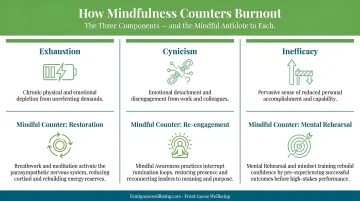
Burnout isn't just feeling tired; it’s a specific syndrome defined by three components:
- Emotional Exhaustion: Feeling depleted of the emotional resources needed to cope with work demands.
- Cynicism: Adopting a detached and negative perspective on your job and colleagues.
- Reduced Professional Efficacy: Doubting your competence and ability to make an impact at work.
Mindfulness directly counters these elements. It fosters emotional regulation to combat exhaustion, promotes non-judgmental awareness to reduce cynicism, and renews focus to restore a sense of efficacy.
A landmark 2024 randomized clinical trial published in JAMA Network Open studied 1,458 employees at a large medical center. The group that participated in an 8-week digital mindfulness program (practicing just 10 minutes a day) showed a dramatic reduction in stress compared to the control group. The results were not only statistically significant but also sustained four months later, demonstrating a lasting impact on employee resilience.
Beyond Stress: The Evidence for Cognitive and Performance Enhancement
While stress reduction is a powerful outcome, the evidence map shows that mindfulness also delivers a direct boost to cognitive functions that are essential for high performance in a modern workplace.
Sharpening Focus and Attention in a Distracted World
Constant interruptions from emails, messages, and notifications fragment our attention, leading to more errors and reduced efficiency. Mindfulness is, at its core, attention training. The practice involves repeatedly bringing your focus back to a single point, like the breath, which strengthens the brain's attention networks.
This isn't just a concept; it's a measurable effect. Studies using fMRI and EEG scans show tangible changes in brain networks related to executive function after mindfulness training. For businesses, this translates to:
- Reduced errors in complex tasks.
- Improved concentration during critical projects.
- The ability to stay on task despite constant interruptions.
This is the science behind the ability to "Get Laser Focused"—a key outcome for leaders and teams navigating information overload.
Boosting Memory, Creativity, and Decision-Making
By quieting the constant mental "noise," mindfulness frees up cognitive resources. Research links this mental clarity to several performance benefits:
- Enhances working memory, improving your ability to hold and process information for complex problem-solving.
- Promotes clearer decision-making by helping you avoid common cognitive traps like the "sunk-cost bias."
- **Boosts creativity and divergent thinking** by creating the mental space needed for novel ideas to emerge.
The 'Soft Skills' Superpower: Evidence for Improved Emotional Intelligence and Collaboration
Emotional intelligence (EQ) is a primary predictor of leadership success and team effectiveness. Mindfulness enhances the two foundational components of EQ: self-awareness and self-regulation. By practicing noticing their own emotional states without judgment, individuals gain the ability to choose how they respond.
This internal improvement has a direct impact on external interactions. A leader who is more self-aware is better equipped to listen empathetically. A team member who can regulate their own stress is less likely to contribute to workplace conflict.
Research connects corporate mindfulness programs with tangible improvements in team dynamics. For example, studies link the practice to reduced emotional exhaustion and improved job satisfaction by enhancing employees' ability to regulate their emotions.
This growing body of evidence also shows that leader mindfulness contributes to higher psychological safety. This creates an environment where team members feel secure enough to speak up, innovate, and take calculated risks.
Putting Evidence into Practice: Implementing a Science-Backed Mindfulness Program
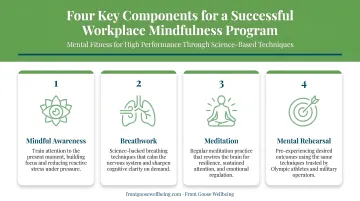
Understanding the evidence is the first step. Translating it into a successful program requires a thoughtful approach that goes beyond simply providing a meditation app. The key components of an effective program include:
- Leadership Buy-In: Success starts at the top, with leaders who model and champion the initiative.
- Structured Training: A curriculum-based approach ensures consistency and builds skills progressively.
- Expert Guidance: A facilitator who understands both mindfulness and the pressures of the corporate world is essential.
- Clear Success Metrics: Tracking pre- and post-program data on stress, productivity, and engagement.
Successfully implementing these components requires a partner who understands the corporate environment. Front Goose Wellbeing, founded by a 25-year HR executive from companies like GE and Kohler, delivers science-based programs that resonate with leadership and produce measurable results.
Frequently Asked Questions
How much meditation is needed to see workplace benefits?
Studies show measurable benefits from as little as 10-12 minutes of consistent daily practice. The key is consistency over duration, building a sustainable habit.
What is the difference between mindfulness and meditation?
Meditation is the formal practice—the dedicated time you set aside to train your attention, like a workout for your brain. Mindfulness is the quality of awareness you cultivate, which you can then apply throughout your entire day.
Can mindfulness really improve a company's bottom line?
Yes. The ROI comes from reduced costs associated with absenteeism and turnover from burnout, higher productivity from improved focus, and better innovation from more collaborative and psychologically safe teams.
Are mindfulness apps enough for a corporate wellness program?
While apps are a good supplement, their usage often drops off quickly. Expert-led programs provide the accountability and customization needed to address specific workplace challenges and drive lasting change.
How do you measure the success of a workplace mindfulness program?
Success is measured using a mix of qualitative feedback (employee surveys on stress and engagement) and quantitative data (tracking metrics like productivity, sick days, and employee retention rates before and after the program).